 ‹ All Blogs
Loan Origination System Implementation: A Step-by-Step Guide for Credit Unions
The short answer: A loan origination system implementation works best in ten ste...

The short answer: A loan origination system implementation works best in ten steps: set goals and name owners, map your current lending process, clean and plan your data, design the integrations, configure instead of customise, complete compliance and vendor due diligence, test the full loan journey, train a team of super users, roll out in phases, and measure the first 90 days. Timelines vary by credit union size, product mix and core. One vendor, Origence, reports that an agile approach can bring a rollout down to 90 to 120 days from about six months, though that figure is the vendor's own experience and not independent research.
Most loan origination projects do not go wrong on launch day. They go wrong in week three, when nobody can say who owns the data, which fields feed the core, or whether the old underwriting policy is actually the one lenders follow.
By the time the problem shows up, the contract is signed, the vendor has a schedule, and your lending team is already tired of hearing about "the new system."
The good news is that the failures are predictable, and so are the fixes. This guide walks through a complete LOS implementation plan, in the order the work should happen, with the questions to settle at each stage, the traps to avoid and a realistic way to think about timelines.
If you are still comparing vendors, start with our loan origination system requirements checklist first and come back here once you have chosen.
What Is a Loan Origination System Implementation?
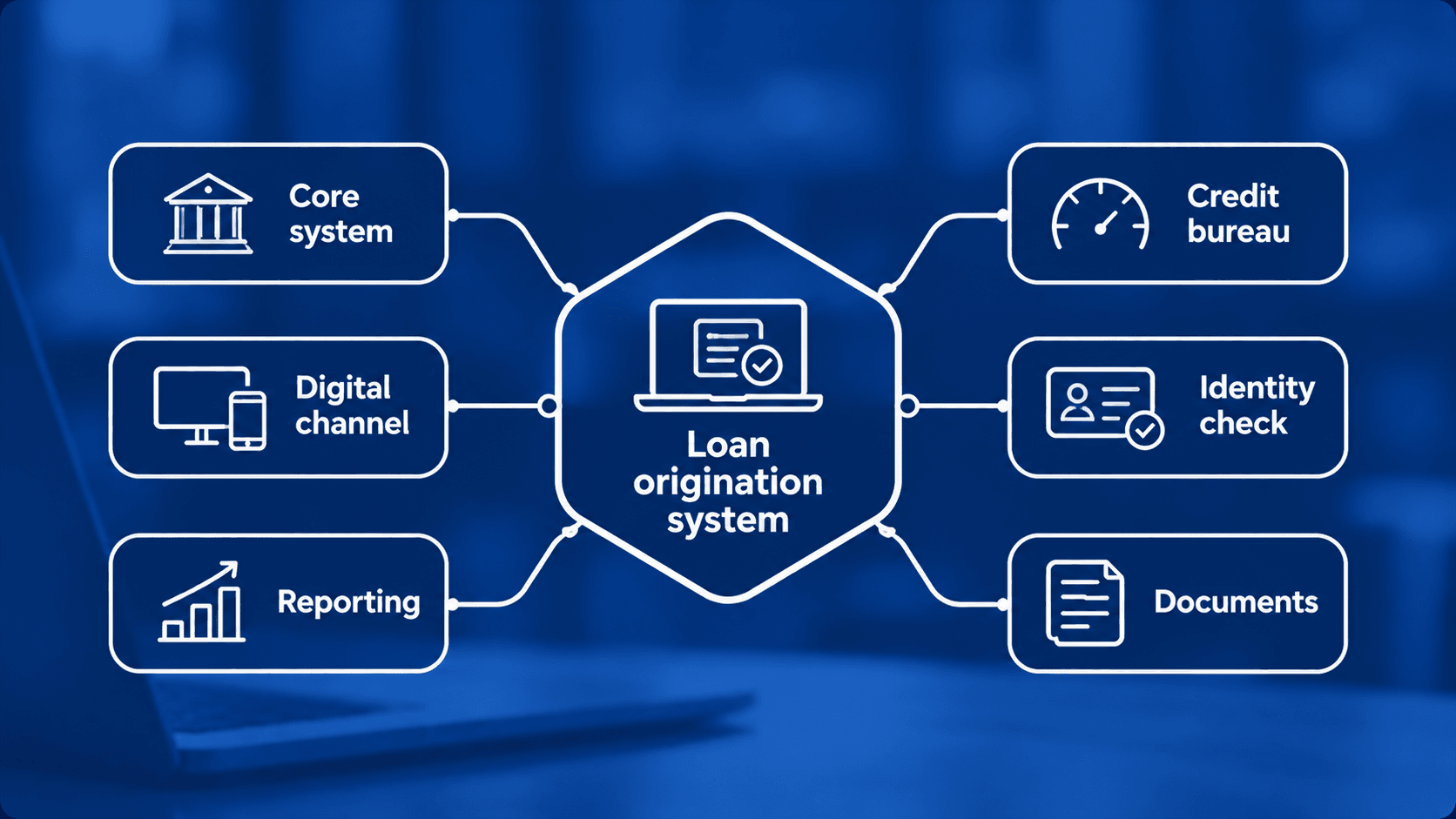
A loan origination system (LOS) implementation is the project of replacing or adding the software that takes a loan from application through decision, documents and funding, then connecting it to everything around it: your core, credit bureaus, identity checks, document tools, digital channels and reporting.
It is bigger than installing software. You are moving data, redesigning handoffs, retraining people and proving to examiners that your controls still hold. That is why the technical go live is usually the smallest part of the work.
How Long Does a Loan Origination System Implementation Take?
There is no honest single number, and anyone who quotes one without asking about your products, core and data is guessing.
What drives the timeline:
Number of loan products. One consumer loan type is simpler than consumer, auto, HELOC and mortgage together.
Core and integration complexity. Every system the LOS must talk to adds work and testing.
Data condition. Clean, consistent records move quickly. Years of inconsistent fields do not.
Your team's availability. Testing and decisions stall when staff have no protected time.
Rollout approach. One branch at a time and everything at once carry different risks.
For reference, Origence authors write in a 2022 CUES article that an agile approach can cut implementation time by as much as 50 percent, from roughly six months to 90 to 120 days. Treat that as one vendor's experience: the piece is sponsored by Origence and offers no outside source for the number. A better use of it is as a reminder that shorter timelines usually come from deciding fast and testing early, not from skipping steps.
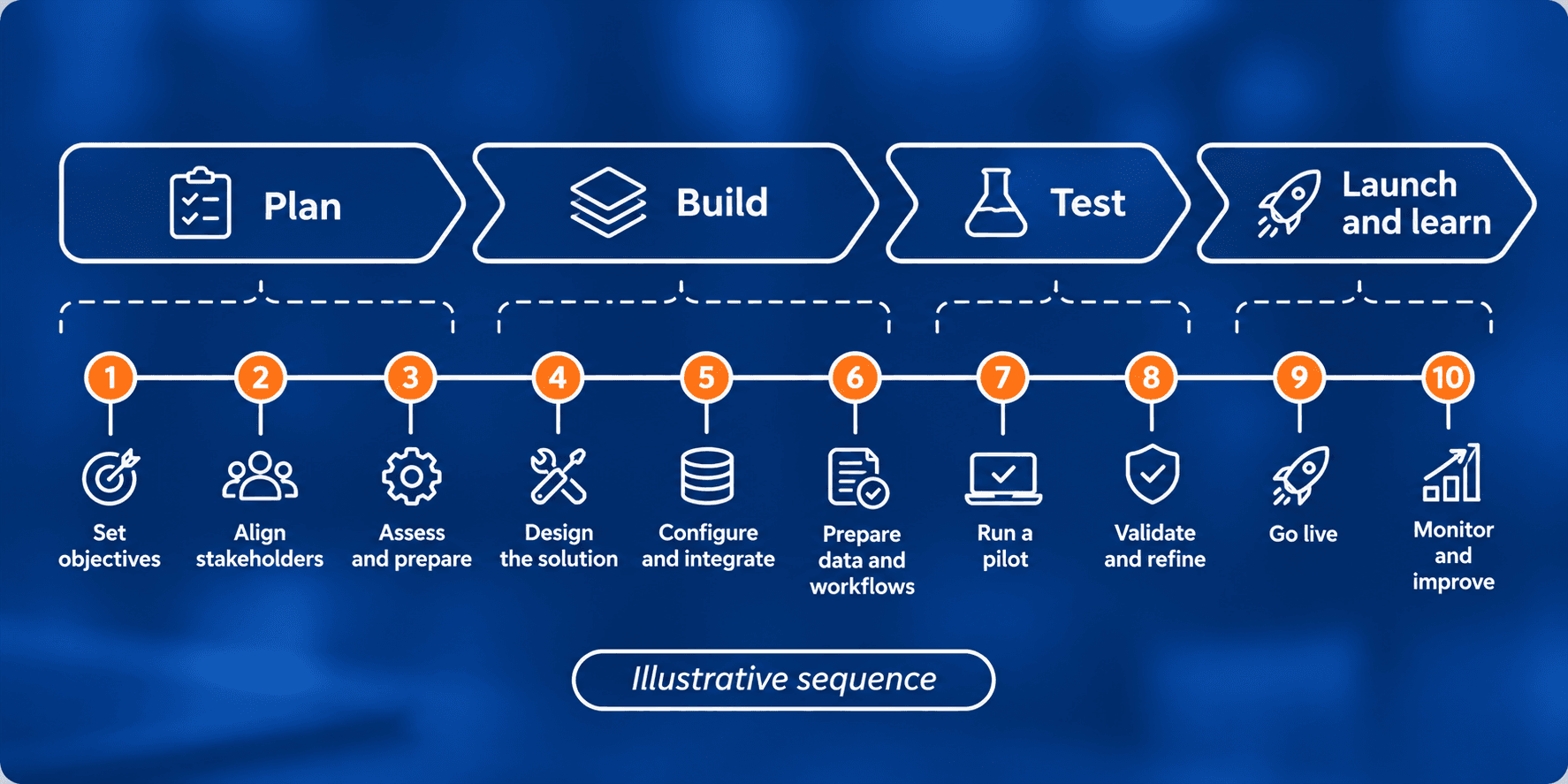
Step 1: Set Goals and Name Owners
Before anyone configures a screen, write down what the project must achieve in plain terms. "Modernize lending" is not a goal. These are:
- Cut the time from application to decision for personal loans.
- Reduce the number of times a lender re keys the same data.
- Give members a clear status at every stage.
- Retire a specific legacy system by a specific quarter.
Then assign owners. A project like this needs one accountable project manager, a business owner from lending, and a named person from compliance, IT and operations. The CUinsight piece on getting a new LOS over the finish line stresses that the project manager should gather information from across the credit union, not just the lending team, with marketing, IT, compliance, the call center and branches all taking part.
Also decide early whether loans and new account opening will roll out together or one after the other. The Origence authors note that launching both at once adds stress. If digital account opening is part of your plan, our guide to optimizing digital account opening can help you decide how to sequence it.
Step 2: Map Your Current Process, Warts and All
Pull the actual workflow, not the one in the policy binder. Sit with a loan officer, a processor and an underwriter and watch how a real application moves.
You are looking for:
Steps nobody remembers the reason for.
Spreadsheets and sticky notes holding the real rules.
Manual handoffs that cause waiting.
Exceptions that happen so often they are really a second process.
This map does two jobs. It shows what the new system must support, and it shows what you should deliberately leave behind. Moving a bad process into a new platform only gives you a faster bad process.
A warning from the Origence authors worth repeating: old workarounds can cause problems in the new system, so keep holding regular meetings after launch to catch them.
Step 3: Audit Your Data and Plan the Migration
Data is the quiet reason projects slip. Before you commit to a schedule, answer these:
What has to move? Open applications, approved but unfunded loans, active loans, historical decisions, documents.
What can stay behind? Closed and archived files may only need to be searchable, not migrated.
How consistent is it? Duplicate members, free text where the new system expects choices, missing fields.
Who cleans it? Data cleanup is staff work and needs time on the calendar.
Data readiness is a sector wide worry, too. In Wipfli's 2026 State of the Credit Union Industry report, based on a fall 2025 survey of 100 credit union executives, 47 percent cited data readiness as a barrier to adopting AI.
If you plan to replace pieces over time rather than all at once, our article on building a modern digital lending stack describes a gradual approach that keeps your core ledger in place while outdated parts are swapped out.
Step 4: Design the Integrations
Your LOS does not live alone. List every system it must exchange data with, and decide what moves in each direction:
- The core, for member records, loan booking and payments.
- Credit bureaus and any alternative data sources.
- Identity verification and fraud tools.
- Document storage, e signature and notices.
- Digital banking and mobile channels.
- Reporting, accounting and compliance tools.
For each one, write down who owns it, what format it uses and what happens when it fails. A simple rule: never let two systems each believe they hold the master copy of the same field.
Fragmented tools are a common source of repeated requests and duplicate entry, which we cover in our piece on why unified consumer finance systems beat fragmented ones. The fewer hops a record makes, the fewer places it can break.
Step 5: Configure, Don't Customize
This is where many projects quietly double in cost. Configuration means using the settings, rules and workflows the platform already offers. Customization means paying for new code to bend the product around your habits.
A good test for any request: is it required by regulation or by a real member need, or is it "how we've always done it"? If it is the latter, try the standard way first. Custom work has a cost that shows up later in upgrades, testing and support.
This is also the moment to set up your decision rules. If you plan to automate approvals for clean applications, define the policy thresholds, the exceptions that go to a person and who may override. Our guide to automated loan decisioning explains how rule based and AI assisted decisions can work with human review still in the loop.
Step 6: Complete Compliance and Vendor Due Diligence
An implementation changes how you collect data, make decisions and communicate with borrowers, so your compliance team should be at the table from the start, not at the end.
Check these before go live:
- Adverse action and notices. Under ECOA and Regulation B, creditors must give applicants specific reasons for adverse action (12 CFR 1002.9). Confirm the new system produces compliant notices on time and with real reasons.
- Records and audit trail. Be able to show who changed what, and when.
- Fair lending monitoring. Make sure the reports you need can be pulled.
- Security. Review the vendor's independent security reports, access controls and incident process.
On vendor oversight, NCUA is clear that credit unions remain fully responsible for third party due diligence, vendor monitoring and contract oversight. NCUA also says it does not review or approve credit union vendor contracts, so that work lands with you.
Rules are shifting here as well. On September 11, 2026, the FDIC, Federal Reserve, OCC and NCUA jointly proposed new interagency third party risk management guidance, with comments due November 16, 2026, according to a Duane Morris summary. It is a proposal and is described as non binding, so check the final text and talk to your compliance team and counsel before relying on any detail.
Negotiate the contract with the whole project in mind: service levels, support response times, data ownership, what happens to your data if you leave, and who pays for changes outside the original scope.
Step 7: Test the Entire Loan Journey
Testing is where you find out whether the plan survives contact with reality, and the credit union, not the vendor, should own it. The Origence authors recommend starting testing early with proven templates and iterating, rather than trying to settle every decision up front, and they note that user acceptance testing should cover the full process, including underwriting, funding and document signing.
Build your test plan around real scenarios:
- A clean application that should be approved instantly.
- A borderline file that needs an underwriter.
- A decline, with the notice that follows.
- A co borrower, a joint account, a self employed applicant.
- A document that is missing, blurry or wrong.
- An integration that times out halfway through.
- A loan that must be funded, booked in the core and appear in reporting.
Ask the people who will use the system every day to run these, not just the project team. Give them protected time. If testing happens "between other tasks," it will be shallow.
If you want to see what a configurable, sandbox style environment feels like before you commit your team's time, you can click through the Algebrik demo and use it as a reference for the kinds of workflows you will want to test.
Step 8: Train a Team of Super Users
Training is not a single session the week before launch. The approach that holds up best is to build internal experts early.
- Pick one or two super users per branch or department.
- Have them learn how the platform is configured and administered, so you are not dependent on the vendor for every small change. The Origence authors recommend staff build and administer the system themselves rather than leave it to the vendor.
- Let them test, then teach their colleagues.
- Keep short guides for the five tasks people do most, and a clear place to ask for help.
People accept a new system faster when someone they trust has already used it and can say, "Here is the quick way."
Step 9: Choose a Rollout Strategy
There are two common ways to launch:
- Phased. One branch, one product or one team first. You learn on a small group and fix problems before they spread.
- All at once. Everyone switches on the same date. It is simpler to communicate and avoids running two systems, but errors reach everyone.
Which fits depends on your size and how well your staff handle change. Many credit unions pick a phased approach for the first product, such as personal loans, then add others as confidence builds.
Consider a short parallel run, where a sample of applications goes through both the old and new process, so you can compare results before you fully switch.
Whichever you choose, prepare a plain rollback plan: what you will do if a serious issue appears in week one, who decides, and how members are told.
Step 10: Go Live and Measure the First 90 Days
Go live is the beginning of the learning, not the end. Set a handful of measures before launch so you can tell whether the project worked:
- Time from application to decision.
- Time from approval to funding.
- Percentage of applications decided without manual touches.
- Applications started versus completed.
- Exceptions and overrides, and the reasons.
- Staff and member feedback.
Compare against the baseline you recorded in Step 1. Review weekly at first, then monthly. Be ready to adjust rules, forms and training as patterns appear.
Who Owns What? A Simple Responsibility Guide
Projects stall when responsibility is vague. A starting split to adapt:
- Executive sponsor: removes obstacles, confirms priorities, signs off on scope changes.
- Project manager: schedule, risks, communication, weekly status.
- Lending lead: policy, workflows, acceptance of testing.
- Compliance lead: notices, records, fair lending, vendor review.
- IT lead: integrations, security, environments, data migration.
- Operations lead: funding, servicing handoff, reporting.
- Vendor team: configuration support, technical guidance, issue resolution.
Write the list down, share it, and revisit it at every phase.
What Mistakes Derail an Implementation?
- Starting without clear goals. Everything becomes a priority, so nothing is.
- Treating it as an IT project. Lending, compliance and operations must co own it.
- Underestimating data cleanup. It rarely fits into the time people hope for.
- Over customizing. Each custom change adds cost now and friction later.
- Testing only the happy path. Real borrowers are messy.
- Skipping training for non users. Branch and call center teams hear the questions first.
- Ignoring contract details. Support terms, data ownership and exit rights matter most when something goes wrong.
- No plan for after launch. Without measures and owners, improvements stop.
The Takeaway
A smooth LOS implementation is mostly about decisions made early: clear goals, named owners, clean data, a short list of integrations, configuration over custom code, real world testing and a team that knows the platform.
Do those things in order, and go live becomes a milestone instead of a gamble.
If you want a concrete reference while you plan, you can explore the Algebrik interactive demo and see how a modern lending workflow is set up, step by step, without a sales call. And if you are weighing vendors, our guide on how to evaluate AI powered lending platforms for credit unions is a good place to start.
Frequently Asked Questions
What is loan origination system implementation?
It is the project of putting a loan origination system into service at a lender, including planning, data migration, integrations, configuration, compliance checks, testing, training and rollout. It ends only when the system is stable and the team is using it confidently.
How long does it take to implement a loan origination system?
What are the main steps in an LOS implementation?
Who should be on the implementation team?
What is the difference between configuration and customization?
Should we roll out in phases or all at once?
How do we handle data migration?
What does NCUA expect when we use a third party vendor?
What should we measure after launch?
Ready to get started?
More Blogs

Blog
Computerized Loan Origination: How Technology Transformed Lending
Blog
Loan Origination System Requirements: A Checklist Before You Buy

Blog
Consumer Finance Systems: Why Unified Platforms Win Over Fragmented Stacks