 ‹ All Blogs
Digital Lending Solutions: Building a Modern Stack
The days of borrowers walking into a physical bank branch, carrying folders stuf...

The days of borrowers walking into a physical bank branch, carrying folders stuffed with tax returns, pay stubs, and bank statements, are rapidly coming to an end. Today’s consumers and business owners expect financial services to be as seamless, intuitive, and instantaneous as ordering a ride or streaming a movie. To meet these skyrocketing expectations, financial institutions are completely rethinking their technology infrastructure.
Over the last few years, lenders focused heavily on “going digital.” Mobile applications were introduced. Borrower portals were launched. Online forms replaced PDFs. But beneath the surface, many institutions still operate on fragmented workflows stitched together through legacy systems, manual reviews, disconnected vendors, and operational workarounds.
That gap is becoming impossible to ignore.
Credit demand is returning across multiple lending categories. Federally insured credit unions closed Q4 2025 with $1.72 trillion in loans outstanding, while assets grew to $2.43 trillion. At the same time, commercial lending expanded 10.9% year-over-year, home equity originations rose 14.3%, and personal loan demand accelerated sharply entering 2026.
The Paradigm Shift: FinTech vs Traditional Bank Lending
To understand where lending is going, we must look at where it has been. The ongoing debate of FinTech vs traditional bank lending often boils down to one critical factor: agility. Legacy banks have historically relied on on-premise servers, siloed data, and highly manual underwriting processes. This resulted in loan approvals taking weeks and a frustrating experience for the applicant.
Conversely, FinTechs were born in the digital age. They leverage modular, API-first technologies that allow for rapid iteration and deployment. The foundation of this agility lies in the undeniable benefits of cloud-based banking software. By migrating to the cloud, modern lenders achieve infinite scalability, enhanced data security, and the ability to seamlessly integrate third-party tools. This interconnected approach breaks down silos, allowing data to flow freely from the initial application all the way through to loan servicing and collection.
Consumers expect instant onboarding, real-time updates, mobile-first experiences, contextual recommendations, and decisions that happen in minutes instead of days. They expect lending journeys to feel connected across channels instead of fragmented between branches, portals, emails, and underwriting queues.
At the same time, lenders are operating inside a far more volatile environment.
Auto loan delinquency rates continued rising through Q4 2025, with TransUnion reporting 60+ day delinquencies reaching 1.50%, while affordability pressures pushed average new vehicle payments to $782 per month.
Meanwhile, TransUnion’s Q1 2026 Consumer Credit Industry Insights report described the U.S. credit market as increasingly “K-shaped,” where super-prime borrowers continue strengthening while non-prime consumers face mounting financial pressure.
This creates a difficult balancing act for lenders.
They must grow originations while improving risk precision. They must accelerate approvals while maintaining compliance. They must improve borrower experience while reducing operational overhead.
Legacy lending systems were not designed for this level of adaptability.
Actionable Tip: If you are transitioning from a legacy system, do not try to rebuild everything at once. Adopt a "strangler fig" approach- gradually replacing the most outdated parts of your system (like paper applications) with digital microservices while keeping the core ledger intact until you are ready for a full migration.
What Is a Modern Lending Stack?
A modern lending stack is not just a Loan Origination System (LOS).
It is a connected lending ecosystem designed to unify origination, decisioning, borrower engagement, analytics, onboarding, compliance, servicing workflows, integrations, and automation into a coordinated operating layer.
Instead of functioning as isolated systems, modern lending technology platforms are increasingly built around orchestration.
That orchestration matters because lending today is no longer linear.
A borrower may begin an application on mobile, continue through a branch, upload documents through a portal, interact with AI-powered support, receive automated reminders, trigger multiple verification workflows, and require dynamic underwriting based on changing risk conditions. All before funding occurs.
Traditional electronic lending systems often struggle because they were built around static workflows. Modern lending environments require adaptive workflows.
That shift is fundamentally changing how institutions evaluate lending technology investments.
Lending Automation Is Becoming a Strategic Requirement
For years, automation in lending was viewed primarily as an efficiency initiative.
Reduce paperwork. Improve turnaround time. Eliminate manual entry.
Those benefits still matter, but lending automation is increasingly becoming a strategic necessity tied directly to competitiveness and portfolio performance.
Consider the current operating environment:
- Household debt in the United States reached $18.8 trillion in Q1 2026.
- HELOC balances continued expanding, reaching $446 billion.
- Personal loan originations surged more than 20% year-over-year entering 2026.
- Credit unions added 2.4 million members through Q4 2025, but median membership growth remained negative for many smaller institutions.
Lenders are simultaneously dealing with rising demand, tighter margins, increasing competition, evolving borrower expectations, and more complex risk environments.
Manual operations simply do not scale effectively under those conditions.
An automated digital lending solution allows institutions to reduce operational friction across the lending lifecycle:
- Automated borrower intake
- Intelligent document collection
- AI-assisted underwriting
- Dynamic decisioning workflows
- Real-time verification
- Integrated compliance monitoring
- Omnichannel communication
- Automated funding workflows
- Continuous portfolio monitoring
The objective is not simply faster lending.
The objective is building a lending operation capable of adapting continuously.
The Real Problem Is Fragmentation
One of the biggest operational challenges facing lenders today is not lack of technology. It is too many disconnected technologies.
Many institutions operate with:
- Separate onboarding systems
- Standalone decision engines
- Disconnected CRM platforms
- Third-party document systems
- Multiple verification vendors
- Legacy servicing tools
- Independent analytics environments
Every handoff introduces friction.
Every disconnected workflow increases operational complexity.
Every manual intervention creates risk exposure, borrower frustration, and slower decision-making.
This fragmentation becomes even more problematic as lending channels expand. Branch, mobile, indirect, embedded, dealer, and digital channels all require operational consistency.
Modern digital lending solutions are increasingly being evaluated based on their ability to unify these experiences rather than simply digitize individual steps.
That is why API-first, cloud-native, modular lending technology architectures are becoming more important across the industry.
Borrower Experience Is Becoming a Competitive Advantage
Lending has historically competed on rates and products.
Increasingly, it is competing on experience.
The institutions gaining momentum are often the ones reducing complexity for borrowers:
- Fewer manual steps
- Faster approvals
- Better transparency
- Omnichannel continuity
- Personalized workflows
- Intelligent communication
- Reduced abandonment
This is particularly important as younger borrowers enter the market.
Digital-native consumers expect lending experiences that resemble modern commerce journeys. They are less tolerant of fragmented applications, repetitive document requests, slow communication cycles, or unclear next steps.
For many lenders, borrower experience is no longer just a marketing concern. It is becoming a growth lever directly tied to conversion rates, member acquisition, retention, and operational efficiency.
AI Is Expanding Beyond Chatbots
One of the most important developments in modern lending stacks is the evolution of AI from isolated functionality into operational infrastructure.
The early wave of AI adoption in lending focused heavily on chatbots and conversational interfaces.
The next wave is far more operational.
AI is increasingly being used to:
- Assist underwriting reviews
- Detect anomalies
- Prioritize workflows
- Generate borrower summaries
- Recommend next-best actions
- Monitor risk signals
- Predict drop-off behavior
- Support compliance review
- Automate operational routing
Importantly, this does not eliminate human oversight. In most modern lending environments, AI works best as an augmentation layer that improves speed, visibility, and decision support while lenders retain control over governance and final approvals.
The future of lending is unlikely to be fully autonomous.
But it will almost certainly be heavily orchestrated through intelligent automation.
Architecting the Modern Lending Stack
Building a successful digital lending platform requires assembling several specialized layers of technology. Each layer must communicate flawlessly with the others, reducing manual intervention and creating a straight-through processing environment.
The borrower’s journey begins at origination. Implementing sophisticated, automated loan origination systems (LOS) is the first step toward modernization. These platforms capture customer data through dynamic, mobile-friendly interfaces. Rather than asking a borrower to fill out a static 10-page PDF, modern origination platforms use conditional logic to only ask relevant questions based on previous answers.
This front-end technology is the engine behind automated loan processing. By automatically routing applications based on predefined rules, lenders can instantly approve low-risk borrowers, decline unqualified applicants, and route borderline cases to a human underwriter, all within seconds.
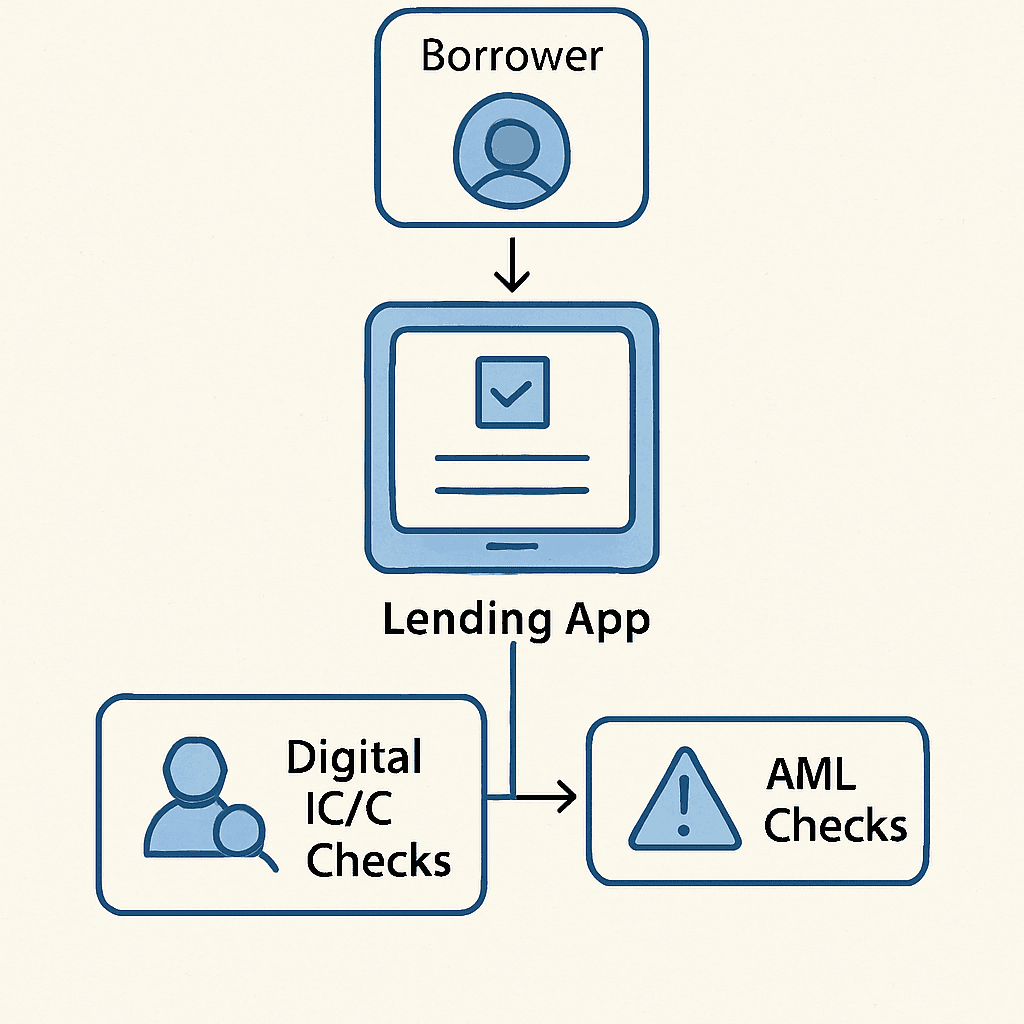
Before any money changes hands, lenders must definitively know who they are dealing with. In the past, this meant reviewing physical IDs in a branch. Today, streamlining digital KYC and AML checks (Know Your Customer and Anti-Money Laundering) is non-negotiable.
Modern identity verification tools use biometric facial recognition, liveness detection, and automated document scanning to verify users in real time. Not only does this drastically reduce fraud, but it also ensures strict regulatory compliance in online finance. When compliance checks are integrated directly into the application flow via APIs, lenders remain on the right side of the law without stalling the customer journey.
Traditional lending heavily relies on legacy credit bureaus. While still useful, these scores often exclude millions of "thin-file" or "credit-invisible" consumers. Modern Digital Lending Solutions solve this by incorporating alternative credit scoring models.
By analyzing alternative data points, such as utility payments, rent history, telecom bills, and even cash-flow behavior derived from open banking APIs, lenders get a holistic view of a borrower's financial health. Furthermore, utilizing real-time data for credit risk assessment allows algorithms to make decisions based on a borrower's financial reality today, rather than relying on a 60-day-old credit report.
Beyond Origination: Underwriting ROI and Post-Loan Management
The benefits of a modern digital lending architecture extend far beyond the moment a loan is funded. The backend operations, where profitability is truly made or lost are equally transformed.
Manual underwriting is expensive. It requires highly paid analysts to spend hours reviewing documents, calculating ratios, and verifying data. By fully utilizing a modern stack, financial institutions realize incredible cost savings of automated underwriting. By reducing the human touchpoints required to process a loan, the cost per origination drops dramatically. Furthermore, because algorithms are less prone to human error and bias, automated underwriting often leads to a higher quality loan portfolio with lower default rates.
Even with the best credit decisioning, some borrowers will inevitably fall behind on payments. Historically, debt collection has been an inefficient, heavy-handed process involving aggressive call centers. Today, however, the impact of machine learning on debt collection is shifting the industry toward a more empathetic, data-driven approach.
Modern collections software uses AI to analyze a borrower's past interaction history, digital behavior, and current economic data to predict when and how they are most likely to repay. For instance, machine learning algorithms might determine that a specific borrower is more likely to respond to a polite SMS reminder on a Friday afternoon offering a customized payment plan, rather than a phone call on a Monday morning. This intelligent, omnichannel approach not only increases recovery rates but also preserves the customer relationship and protects the brand's reputation.
Conclusion
Building a modern lending stack is no longer an optional upgrade reserved for highly funded tech startups; it is a fundamental requirement for any institution looking to remain competitive in the modern financial ecosystem.
By moving away from siloed legacy systems and embracing comprehensive Digital Lending Solutions, organizations can transform their entire operational model. From leveraging real-time data and alternative scoring for smarter credit decisions, to embedding finance directly into consumer touchpoints, the right technology stack enables unmatched agility. Ultimately, investing in these modern infrastructures allows lenders to do what they do best: provide vital capital to the people and businesses that need it, swiftly, securely, and profitably.
Ready to get started?
More Blogs

Blog
Computerized Loan Origination: How Technology Transformed Lending

Blog
Loan Origination System Requirements: A Checklist Before You Buy

Blog
Consumer Finance Systems: Why Unified Platforms Win Over Fragmented Stacks