 ‹ All Blogs
Loan Application Abandonment: Why Credit Unions Lose Borrowers Before Loan Approval
The short answer: Borrowers abandon loan applications mostly because the process...

The short answer: Borrowers abandon loan applications mostly because the process asks too much, takes too long, or leaves them in the dark. The usual culprits are long or repeated forms, a membership or account gate before they see any answer, document uploads that fail on a phone, slow decisions, and silence after they hit submit. Credit unions can win these borrowers back by measuring exactly where they leave, shortening and prefilling the form, replacing uploads with direct data connections, answering in minutes, and following up automatically.
It's 8:40 on a Saturday night. A member is at her kitchen counter with her phone, finally tackling the credit card balances she has been meaning to consolidate. She opens your app, taps "Apply for a personal loan," and gets through the first two screens without a hiccup.
Then page three asks her to upload two recent pay stubs.
She doesn't have them on her phone. They are in a drawer somewhere, or in an email she would have to dig up. She tells herself she will finish tomorrow and closes the app.
On Sunday morning, an offer from an online lender lands in her inbox. It promises a decision in minutes, with no paperwork. She clicks.
Here is the part that should bother you. Nobody at your credit union will ever know this happened. There was no denial to review, no complaint to answer, no survey response to read. Your system logged an application that was started and never finished, and the file quietly aged out.
That is loan application abandonment. It is the quietest loss in lending, and for many credit unions it is also one of the biggest.
So let's talk about why it happens, where exactly borrowers leave, how to measure your own leak, and what to fix first.
What Is Loan Application Abandonment?
Loan application abandonment happens when a borrower starts a loan application with your credit union and leaves before the process finishes. It comes in two forms, and they need different fixes:
- Before submit. The member starts the application, then stops somewhere in the form, often at a document request, a long section or a question that raises a worry.
- After submit. The member finishes the application but disappears before funding. They may be waiting too long for a decision, confused by the next step, or lost to a competing offer that arrived first.
A third category is murkier. Some people were never applying at all. They were using a payment calculator or comparing rates, and they show up in your data as "abandoned." CU Times, in a piece by an AdvantEdge Digital executive, points out that a shopper who uses a payment calculator and then leaves to check dealer inventory can get logged as an abandoned application. Separating real drop offs from window shoppers is part of measuring this honestly.
How Big Is the Problem?
Here is the honest answer: nobody can hand you a reliable number, and you should be wary of anyone who does.
Search for "loan application abandonment rate" and you will find figures anywhere from the 50s to the 80s, repeated across vendor blogs. Many of them cite no study, and others quietly mix credit card checkouts, account opening and ordinary online shopping together. Your rate depends on your product, your channel and your form. The only number that matters is yours, and most credit unions have never calculated it. In the same CU Times piece, the author notes that some lenders treat abandonment as a cost of doing digital business, and others do not track it at all.
What we can lean on is the best documented research on why people walk away from online forms. The Baymard Institute, which has studied checkout behavior for years, puts the average documented online shopping cart abandonment rate at 70.22 percent, drawn from 50 studies published between 2006 and 2025. That is retail, not lending, and a loan is a far bigger decision than a pair of shoes. But the reasons people give are strikingly familiar. Among US shoppers who had a reason to leave, Baymard's research lists 19 percent who did not trust the site with their card information, 18 percent who were forced to create an account, and 17 percent who found the checkout too long or complicated.
Swap "checkout" for "loan application," and those three reasons describe a lot of credit union journeys: trust worries, a membership gate, and a form that feels like homework.
Meanwhile, the pressure to get digital right keeps growing. Wipfli's 2026 State of the Credit Union Industry report, based on a fall 2025 survey of 100 credit union executives, found that improving digital member engagement was the top strategic priority at 64 percent. Wipfli's 2027 report, released in November 2026, says it remains among the top strategic focus areas.
Where Do Borrowers Actually Leave?
Think of your application as a hallway with a few doors people can slip out of. Here are the seven that come up most.
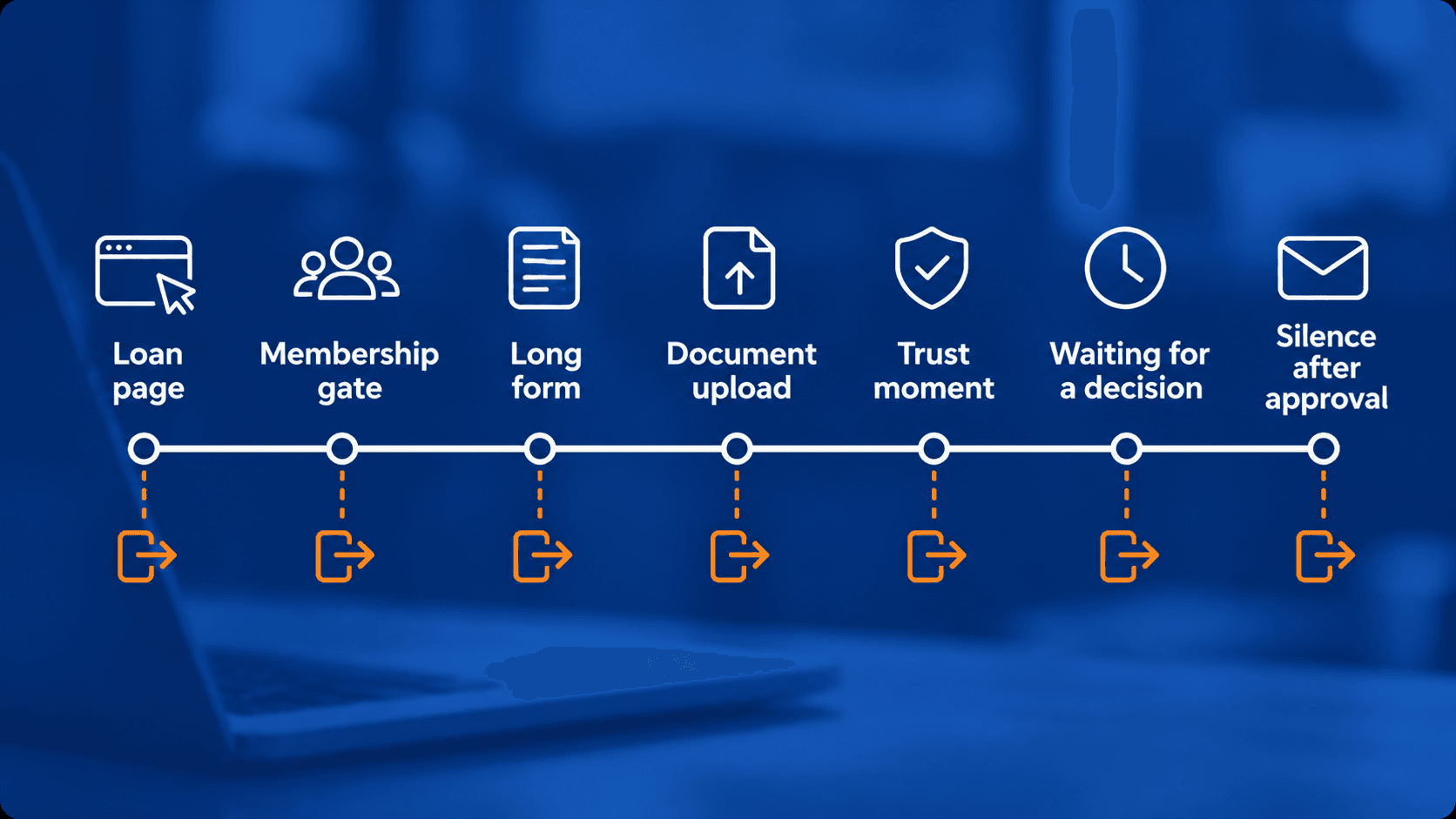
1. The Loan Page, Before They Start
Some of your visitors never click "Apply." They hit a page with no clear rate, no idea of how long the application takes, and a wall of text about eligibility. A little clarity goes a long way: show what the loan costs, what is needed, and how long it takes. If your target is a five to ten minute application, say so. CU Times cites CUNA Mutual Group research indicating that most credit unions would be satisfied with an online application that takes five to ten minutes, as long as it needs few follow ups with the borrower.
2. The Membership or Account Gate
Making someone create an account, open a share account or prove membership before they learn whether they qualify is one of the oldest ways to lose them. Baymard's data shows forced account creation is a top reason shoppers leave in retail, and the lending version is even heavier, since it involves money and paperwork.
Where your policy and field of membership rules allow, consider letting people apply first and complete membership as part of closing. Our guide to point of sale lending for credit unions argues for exactly this, noting that requiring a share account before a financing decision causes abandonment, and recommending that membership be created during loan closing instead.
3. The Long, Repetitive Form
Every extra field is a small reason to quit, and mobile screens make each one feel larger. The usual offenders:
Asking for details you already hold. An existing member's name, address and employer should not need retyping.
Asking the same thing twice in different words.
Forms that were designed for a desktop and squeezed onto a phone.
No progress indicator, so nobody knows if they are halfway or nearly done.
No "save and finish later" option.
Our piece on fixing digital onboarding goes deeper on form friction, prefilled data and mobile design, particularly for younger borrowers.
4. The Document Upload
This is the door our Saturday night member walked through. Asking for pay stubs, bank statements or tax forms in the middle of a mobile application is a classic stopping point. People do not have the files handy, the upload fails, or they are not sure which document you mean.
A better pattern is to avoid the upload entirely. With the member's consent, income and account information can arrive directly from the source, so nobody photographs a pay stub at an angle in poor light. Algebrik's partnership with Conductiv is built on this idea, and we explain it in our announcement on permissioned data and automated stipulations. Keep an upload path for people who prefer it, but make the easy path the default.
If you do need documents, ask for everything in one request, tell people exactly what counts, and let them add the files later without losing their place.
5. The Trust Moment
Somewhere in every application, you ask for something sensitive: a Social Security number, a bank connection, consent to pull credit. This is where hesitation spikes. Baymard found that 19 percent of shoppers with a reason to leave did not trust the site with their payment information, and loans ask for far more.
You can calm this with a few small touches:
Say why you need it, in a sentence, right where you ask.
Be honest about what happens next, including whether it affects their credit, and only say what is true for your process.
Show a visible security cue and a way to reach a real person.
Keep your branding and tone consistent, so the screen feels like the credit union they already know.
6. The Wait for a Decision
After the member hits submit, time starts to matter. If the answer takes days, they keep shopping, and a competitor who answers first often wins. Online lenders have taught everyone to expect speed, and your members compare you with them, whether that feels fair or not.
Instant decisions for clean, in policy applications fix most of this, and they free your lenders for the files that need judgment. We explain how automated loan decisioning works with human review still in the loop.
7. Silence After Approval
Plenty of borrowers are lost after they have been approved. The member gets a message that says "approved," then nothing. No clear next step. A signature request buried in email. A funding date nobody can explain. Our article on improving the member experience in credit union lending calls silence the most common complaint in lending, and that matches what many teams hear. Automatic status updates, with a clear next step each time, close the gap.
Our point of sale guide also notes that signature links sent by email convert poorly when the borrower is still standing at the merchant, and suggests text messages instead. If your members are mid purchase, that small change can matter.
What Is Really Behind All Seven?
Look back over that list and a pattern shows up. A form can be redesigned in a week. But if your documents live in one system, your decisioning in another and your messaging in a third, every handoff is a place where a borrower can fall out of the process, repeat themselves or hear nothing.
Our article on consumer finance systems and why unified platforms beat fragmented ones explains how disconnected tools create repeated requests, duplicate data entry and restarts across channels. Fixing the front end helps. Connecting what sits behind it helps more.
How Do You Measure Your Own Abandonment?
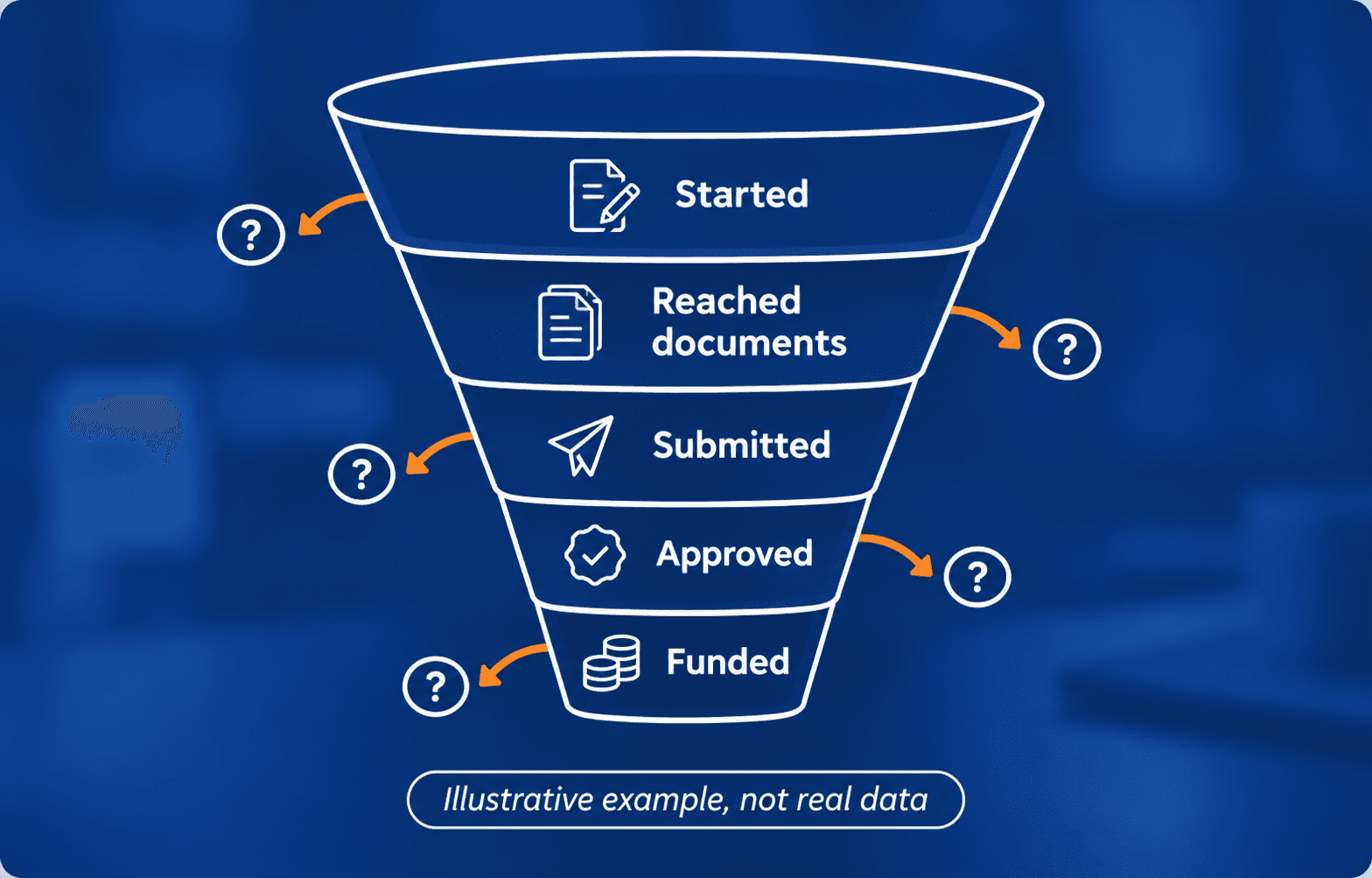
You cannot fix a leak you cannot see, and this is the step most credit unions skip. Start with a simple funnel for each loan product.
Track these at every step, not just overall:
- Visitors who start an application. Start rate from your loan page.
- Step completion. The share who finish each screen, and how long each one takes.
- Device split. Phone versus desktop. A gap here is often the first big clue.
- Submit rate. Of everyone who started, how many finished.
- Decision to acceptance. Of approved borrowers, how many accepted.
- Funding rate. Of accepted offers, how many funded, and how many days it took.
- Time to first response. How long a member waits before hearing from you.
Here is an illustration with made up numbers. Out of 1,000 started applications, 720 reach the document step, 540 submit, 470 are approved and 400 fund. You can see the biggest single drop sits between "reached documents" and "submit," losing 180 people. That is where you would look first. Your own numbers will differ, and that is the point.
Then add the human layer. Talk to a handful of members who dropped off, and to a handful who finished. The CU Times piece recommends talking one on one with members who used your solution to learn what made them leave. Ten honest conversations will tell you things no dashboard can.
Whatever platform you use, ours included, it should report abandonment by step, by device and by product, and should show you the drop between submit and funding. If your system cannot tell you where people leave, that is a finding in itself.
What Should You Fix First?
Start with the changes that cost the least and move the number the most.
This month:
- Count your fields and delete every one you do not truly need.
- Prefill everything you already know about existing members.
- Add a progress bar and a "save and finish later" option.
- Tell people up front how long the application takes and what they need.
- Test the whole journey on a phone, on a slow connection, with a real person who did not build it.
This quarter:
- Replace document uploads with direct data connections for most borrowers.
- Move the membership step later in the process where your policy allows.
- Give clean applications an instant decision.
- Send automatic status updates at every stage, with the next step spelled out.
Then, follow up:
- Reach people who left. CU Times suggests personal outreach or an email around 48 hours after they exit. Make sure any message, especially texts, follows your consent and communication rules.
- Send a save and resume link so they can pick up where they stopped.
- Offer a call from a real person for larger or more complex loans.
Want to see what a short, guided application with live status looks like? You can try the interactive Algebrik demo and click through a lending workflow at your own pace, no sales call needed.
What Mistakes Make Abandonment Worse?
- Treating it as a cost of doing business. It is a fixable leak, and every lost borrower is a lost member relationship.
- Only looking at the overall rate. An average hides the one screen that is causing the damage.
- Counting window shoppers as failures. Clean up your data so calculator users and real applicants are separated.
- Redesigning the form and ignoring the back office. A pretty front end cannot cover for slow decisions and silent handoffs.
- Forgetting what happens after approval. Some of your biggest losses happen after you said yes.
- Chasing too hard. One helpful follow up works. Five in a day makes people block you.
- Skipping the member conversation. Data shows where people leave. Only people can tell you why.
The Takeaway
Most borrowers who walk away from your loan application never tell you why. They just stop.
That is why the first job is to see the leak: measure each step, split phones from desktops, and talk to a few people who left. The second job is to remove what does not belong. Fewer fields, no membership wall in the way, no document hunt on a Saturday night, quick answers and clear next steps.
Do that, and the member at the kitchen counter finishes her application before the other offer ever reaches her inbox.
If you would like to see how a guided, mobile friendly lending journey comes together in practice, explore the interactive demo at your own pace.
Frequently Asked Questions
What is loan application abandonment?
Loan application abandonment is when a borrower starts a loan application and leaves before it is finished. It can happen before the application is submitted, such as at a document request, or after submission, while waiting for a decision or between approval and funding.
What is a normal loan application abandonment rate?
Why do borrowers abandon loan applications?
How can credit unions reduce loan application abandonment?
How do you calculate loan application abandonment?
How long should an online loan application take?
Is an abandoned application a lost member?
Ready to get started?
More Blogs

Blog
Computerized Loan Origination: How Technology Transformed Lending
Blog
Loan Origination System Requirements: A Checklist Before You Buy

Blog
Consumer Finance Systems: Why Unified Platforms Win Over Fragmented Stacks