 ‹ All Blogs
How Long Does Loan Origination System Implementation Take?
The short answer: Most credit union loan origination system (LOS) projects take...

The short answer: Most credit union loan origination system (LOS) projects take roughly two to six months from signed contract to go live, though simple single product launches are reported in weeks and multi product, heavily integrated rollouts can run longer. That range is a pattern across published vendor figures, not an independent study, and it leaves out the months many credit unions spend on vendor selection, board approvals and contract review before the clock officially starts. What moves your number most is not the software. It is how clean your data is, how many systems must connect, how many loan products launch together, and how much protected time your own staff can give the project.
Ask five vendors how long implementation takes and you will get five confident answers that do not agree with each other.
Nobody is necessarily lying. They are answering different questions. One is describing a single product launch with a clean file. Another is describing a full multi product rollout with a core conversion next door. A third is counting from the day you sign, while you were counting from the day your board first discussed the problem.
So let's do something more useful than quote a single number. This guide shows the real ranges that vendors and credit unions have published, explains what stretches or shrinks them, gives you a sample schedule you can adapt, and ends with the questions that expose an unrealistic promise before you sign it.
How Long Does a Loan Origination System Implementation Actually Take?
Here is what the published sources say, with the caveat that nearly all of them come from vendors describing their own projects.
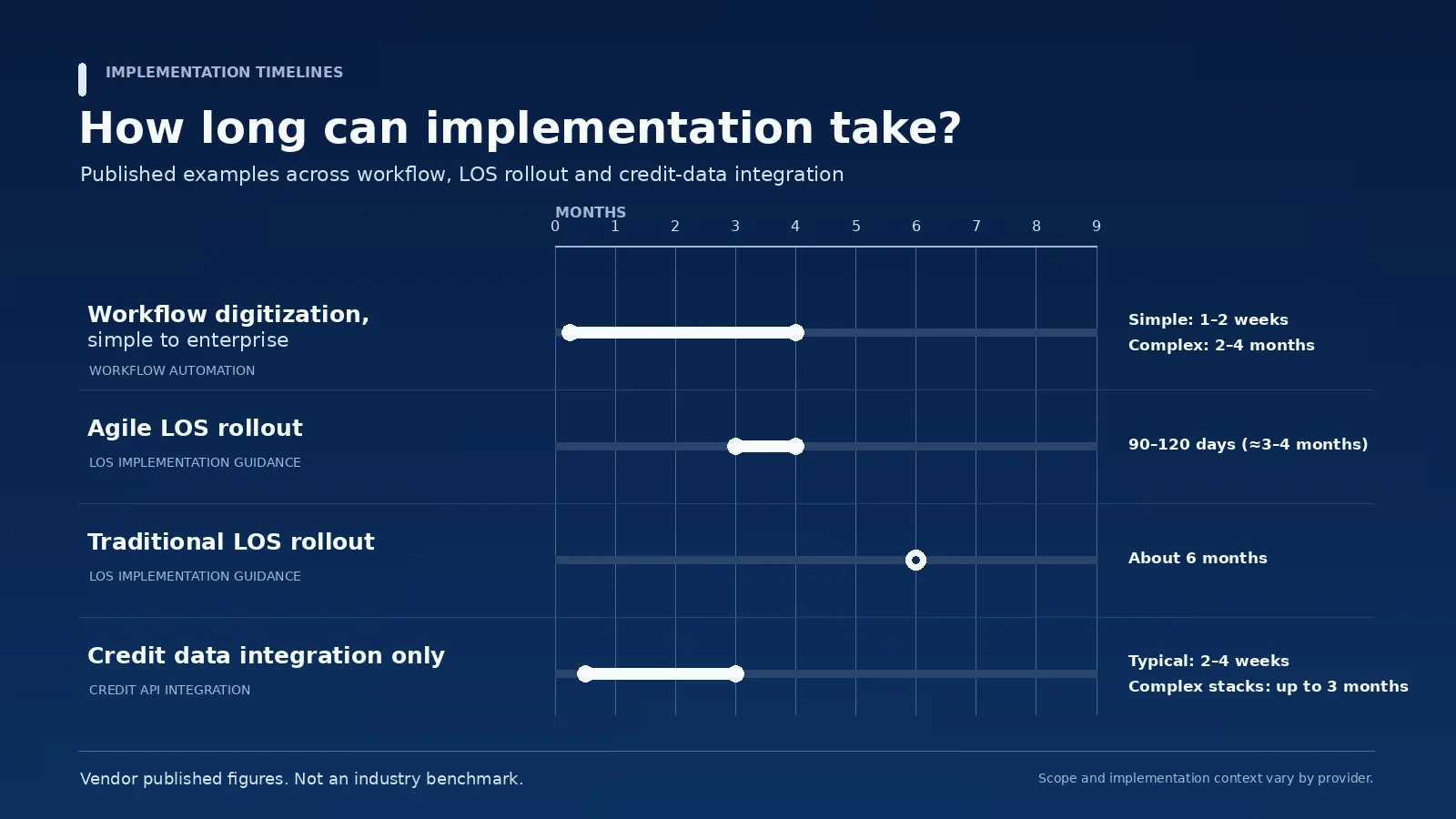
- Agile rollout, as reported by Origence. In a 2022 CUES article, Origence authors say an agile approach can cut implementation time by as much as 50 percent, bringing a rollout from roughly six months to 90 to 120 days. The piece is sponsored by Origence and gives no outside source for the number.
- A six month working rhythm, as described by Jack Henry. In a February 2026 article, Kristin Zell advises credit unions to expect two to three hours a week of virtual meetings over six months. It is a staffing expectation, not a promise about the end date, but it hints at the scale of effort.
- A three month express approach, as marketed by West Monroe. This September 2021 overview describes four phases over a three month period. The timing and return claims are the consulting firm's own, and the comparison it uses is not defined.
- Mortgage LOS projects, as reported by MeridianLink. A June 2026 MeridianLink post cites a fastest implementation of 58 days and says the company completed 39 mortgage LOS deployments in a year, several in under 60 days. These are best case examples, and the post gives no average or median.
- Digitizing a loan workflow, as reported by EasySend. A July 2026 EasySend article puts a simple personal loan application at 2 to 6 weeks, a consumer lending workflow at 4 to 8 weeks, a commercial lending workflow at 2 to 4 months and enterprise origination across multiple products at 3 to 6 months. That is about building digital workflows with its own product, so use it for the shape of the curve more than the exact weeks.
- Credit data integration alone, as reported by CRS. CRS says most LOS credit API integrations take two to four weeks, some go live in two, and complex stacks can take up to three months. Its page also gives slightly different figures in a later section, which is a good reminder to treat any single vendor number loosely.
Put those side by side and a pattern appears. Simple, single product launches show up in weeks. A conventional consumer LOS rollout clusters around three to six months. Wider scope, such as several products, several integrations or a core change underway, pushes past that.
That is a pattern, not a rule. Nobody has published a large, independent study of credit union LOS timelines, and any article claiming "the average implementation takes X weeks" is repeating a vendor's own results.
What Does the Clock Leave Out?
Quoted timelines usually start at contract signature. Your real project starts earlier and ends later.
Before the contract:
- Current state assessment and requirements gathering.
- Steering committee, budget approval and board sign offs.
- Requests for proposals, demos and reference calls.
- Vendor due diligence and contract negotiation.
MeridianLink's post notes that due diligence and vendor selection can extend the overall timeline "by months" for credit unions and banks, and that if your current contract renews in 12 to 18 months, the time to start is now.
On vendor oversight specifically, NCUA states that credit unions remain fully responsible for third party due diligence, vendor monitoring and contract oversight, and that it does not review or approve credit union vendor contracts. That work takes calendar time, and it belongs to you.
After go live:
- A parallel period where the old system stays available. MeridianLink advises targeting go live 30 to 60 days before you lose access to the old system, and says that buffer is often overlooked (the post's 85 percent figure for how often is a presenter's estimate, not measured data).
- Loans already in flight that must finish where they started.
- Stabilization, fixes and tuning of rules and forms.
- Retiring the old system and archiving its data.
If someone asks "how long will it take?", the honest reply is another question: from which date to which date?
What Makes an Implementation Take Longer?
Across the sources, the same slowdowns come up again and again. These are the ones to look for in your own plan.
1. Messy Data
CRS calls inconsistent legacy data formats, such as names, addresses and phone numbers, the biggest obstacle in credit integrations. The same applies to migrating member and loan records. Duplicates, free text where the new system expects choices and missing fields take real staff hours to fix, and no vendor can fix them for you.
For a broader view of how common data readiness concerns are, Wipfli's 2026 State of the Credit Union Industry report, based on a fall 2025 survey of 100 credit union executives, found 47 percent cited data readiness as a barrier to adopting AI.
2. Too Many Integrations
Each connection, whether to the core, a bureau, identity checks, document tools or digital banking, needs design, credentials and testing. Weak error handling and skipped test phases show up in production, CRS warns. Counting your integrations early is the single best way to size your schedule.
3. Launching Everything at Once
Several loan products, plus account opening, plus a new channel is a bigger project than any one of them. The Origence authors note that rolling out loans and new accounts together adds stress. Phasing by product often shortens the time to first value, even if the total calendar time is similar.
4. Slow Decisions on Your Side
MeridianLink's post lists internal approval cycles, slow responses and delays in securing third party vendor credentials among the main drivers. If every configuration choice needs a committee, the schedule stretches no matter how fast the vendor works.
5. Staff Without Protected Time
Testing "between other tasks" is shallow testing. Jack Henry's advice to build a committed team, with weekly engagement from stakeholders to test, validate and confirm milestones, points at the same problem. If your best people cannot clear time, the project will wait for them.
6. Customization Creep
Every "can we make it work exactly like our old system?" request adds build and test time. Configuring what the platform already offers is almost always faster than writing new code around old habits.
7. Compliance Discovered Late
Notice templates, adverse action procedures and audit trails that are reviewed at the end tend to be fixed at the end, too, which means rework. CRS makes the same point about credit data: gaps in compliance procedures must be fixed before go live. Bring compliance in at the start.
What Makes It Faster?
The good news is that time is not fixed. These habits show up in every credible account of a quick rollout.
- Start with one product. Launch the product with the clearest need, usually personal loans, and add others afterward. Our guide to personal loan origination for credit unions describes a staged approach to auto funding: begin with the strongest credit tier, measure for 90 days, then expand.
- Decide requirements before configuration. MeridianLink says clear requirements and tight collaboration between lender and provider can compress timelines without hurting stability. Our LOS requirements checklist is a good starting point for that conversation.
- Choose quick win rules first. MeridianLink suggests starting with simple automation, such as approving very strong applicants and declining very weak ones, before tackling complex files. Our explainer on automated loan decisioning shows how rules and human review fit together.
- Use prebuilt connections where they exist. A platform that already has your bureau or data partners built in avoids a custom project. Algebrik's Equifax partnership announcement, for example, says the integration works without requiring additional implementation cycles. Ask every vendor to list which of your connections are already built.
- Test early and often. Origence recommends starting testing early and iterating instead of trying to settle every decision up front.
- Name a project manager with authority. Clear internal ownership comes up in nearly every list of timeline drivers.
- Replace pieces over time when a full swap is too risky. Our article on building a modern lending stack describes a gradual approach that keeps your core in place while outdated parts are replaced.
Not sure which workflows you would actually need on day one? You can click through the Algebrik interactive demo at your own pace. Seeing a modern lending journey end to end is a fast way to decide what belongs in phase one and what can wait.
What Does a Realistic Timeline Look Like? Three Sketches
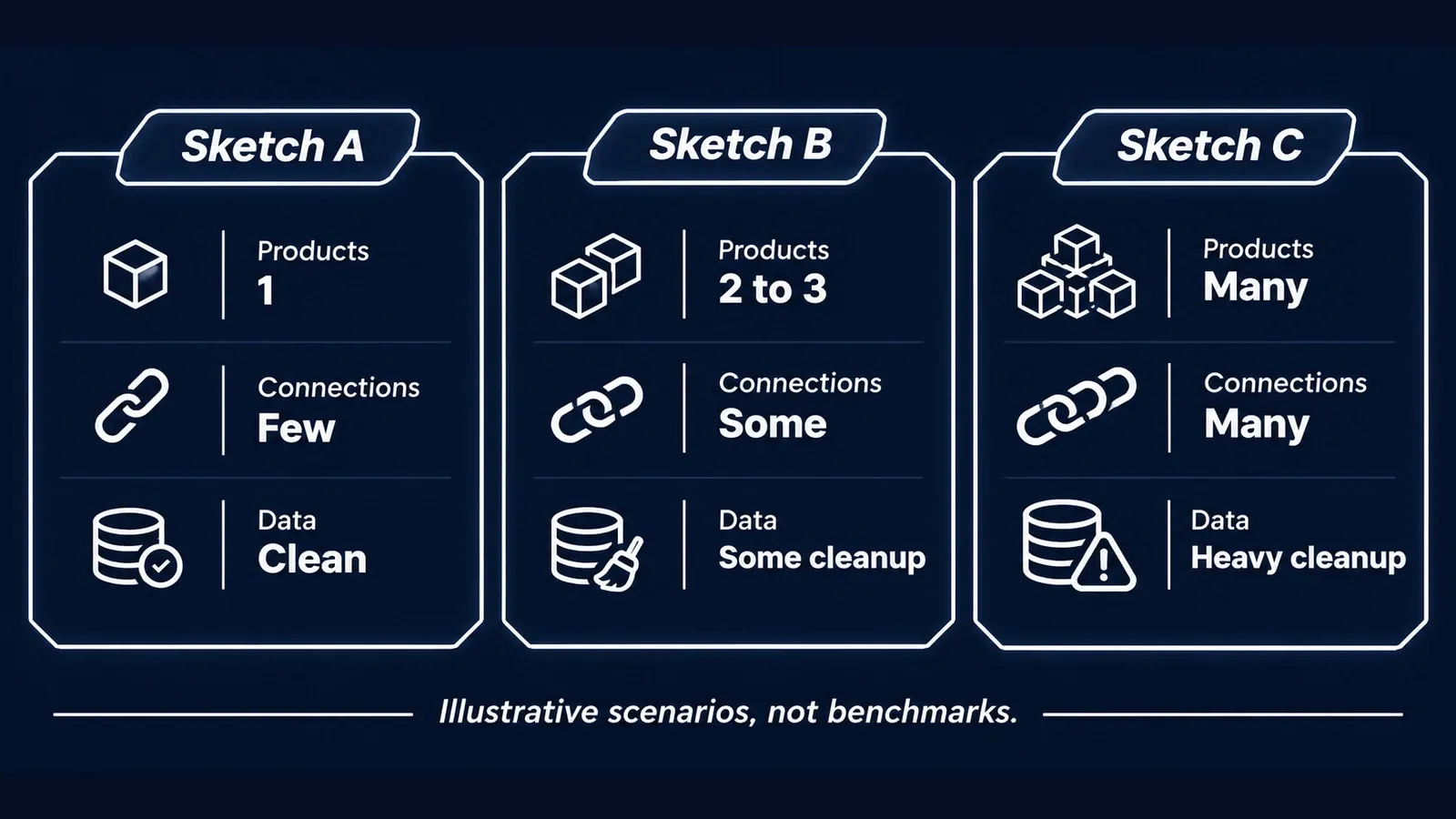
These are my own illustrations based on the drivers above, not benchmark data. Use them to think, then replace them with your vendor's plan.
Sketch A: One product, clean data, standard connections, a small committed team. This sits at the faster end of the published ranges. Think weeks to a few months from contract to a first live product, assuming decisions are quick and the team has time to test.
Sketch B: Two or three consumer products, core integration, some data cleanup. This is the middle of the pack, and it fits the three to six month range seen in several sources. Most credit unions will recognize themselves here.
Sketch C: Many products including mortgage or commercial, older systems, several branches, formal approvals at every step. Expect longer than six months, and expect the work to be phased. Trying to compress this into one date is how projects get into trouble.
A Sample Schedule You Can Adapt (Illustrative)
Here is how a single consumer loan product might be planned over about 16 weeks to a first live pilot, followed by expansion. Treat it as a template for conversation with your vendor, not a promise.
Weeks 1 to 2: Kickoff, goals, owners, scope and a baseline of your current numbers.
Weeks 2 to 5: Process mapping, data audit and integration design. Compliance reviews notices and records.
Weeks 4 to 10: Configuration, connections to the core and data sources, first test migration.
Weeks 9 to 13: User acceptance testing with real scenarios and the people who will use the system.
Weeks 12 to 14: Super user training and staff walkthroughs.
Weeks 14 to 16: Pilot launch with a limited group, with a rollback plan ready.
Weeks 16 to 26: Expand to more branches or products, review weekly, tune rules and forms.
Notice that phases overlap. Sequencing everything strictly one after another adds weeks without adding safety.
How Do You Estimate Your Own Timeline?
Before you accept anyone's number, answer these questions about your own situation. The more "it depends" answers you give, the more buffer you need.
- How many loan products will launch together?
- How many systems must connect, and which ones are already built by the vendor?
- How clean is your member and loan data, and who will fix it?
- Who owns the project, and what share of their week is protected for it?
- How many approvals does a configuration decision need?
- What must be true for compliance and your board before launch?
- Will you phase by product, branch or team, or launch everywhere?
- How long must the old system stay available?
Add up the answers, take the vendor's timeline for the matching scenario, and add a cushion for the items that are still unknown. A schedule with no slack is a wish.
What Should You Ask a Vendor About Timing?
A good vendor answers these without flinching. A weak answer is information, too.
What is the median timeline for credit unions of my size and product mix, not your fastest case?
What does that timeline assume about my data, integrations and staff availability?
Which of my systems already have prebuilt connections, and which need custom work?
What do you need from us each week, in hours and roles?
What typically causes delays, and how often does it happen?
Can I speak to two reference customers who launched in the last year?
What happens if the schedule slips, and who bears the cost?
How long will you support parallel running, and how do you handle loans in flight?
Ask us the same things if you are evaluating Algebrik. Whatever the answers, get them in writing in the statement of work.
The Takeaway
The question "how long does it take?" has a useful answer only when you give it your own details: what you are launching, what it must connect to, how good your data is and who has the time to do the work.
Published figures put most credit union projects somewhere between a couple of months and half a year, with the shortest ones built on narrow scope and fast decisions. The delays almost always come from the same few places, and most of them are inside your control.
Start by measuring your own data and integration list, ask vendors for the assumptions behind their numbers, and plan backwards from your contract end date.
If you want a concrete picture of what a modern lending workflow looks like while you plan, you can explore the Algebrik demo whenever it suits you. And if you are still choosing a platform, our guide to evaluating AI powered lending platforms for credit unions will help you compare options on more than speed.
Frequently Asked Questions
How long does it take to implement a loan origination system?
Published vendor figures cluster around two to six months from contract to go live for credit union consumer lending, with simple single product launches reported in weeks and complex multi product projects running longer. These are vendor reported ranges, not an independent benchmark, and they exclude vendor selection, approvals and contract time before signing.
Can a loan origination system be implemented in 30 days?
Why do LOS implementations take longer than expected?
How long does data migration take?
How long does it take to integrate a loan origination system with a core or credit bureau?
Does a phased rollout take longer?
Ready to get started?
More Blogs

Blog
Computerized Loan Origination: How Technology Transformed Lending

Blog
Loan Origination System Requirements: A Checklist Before You Buy

Blog
Consumer Finance Systems: Why Unified Platforms Win Over Fragmented Stacks