 ‹ All Blogs
How to Reduce Loan Processing Time at Credit Unions Without Adding Staff
The short answer: You reduce loan processing time at a credit union by removing...

The short answer: You reduce loan processing time at a credit union by removing waiting, not by making people work faster. Capture application data once, collect documents and income digitally, automate stipulation chasing, let software decide the clean files, route exceptions to the right person, and send status updates automatically. Most of the time a file loses is spent sitting in a queue, so freeing those gaps shortens turnaround and gives your existing team room to handle more volume.
It's 4:15 on a Thursday afternoon, and a loan officer is staring at 38 open files.
None of them is difficult. One is waiting on a pay stub. One is waiting on a second pair of eyes. One is waiting on a dealer to fix a signature date. One is a member who called twice today to ask where things stand, and a callback sits on a sticky note beside the monitor.
Nobody on this team is slow. They are all busy, which is a different thing, and the difference matters. When you ask what is holding up these files, the honest answer is rarely "someone is working too slowly." It's "nobody has touched it yet."
That's good news, because waiting is much easier to remove than effort. And it means the usual fix, hiring another processor, often treats the wrong problem.
So let's walk through where loan processing time really goes at a credit union, the specific changes that shrink it, and how to start without adding a single headcount.
Because growth and speed have become the same conversation.
Cornerstone Advisors' 2026 research, as reported by CU Today, found that new member growth is now the top concern for 69 percent of credit union leaders, up from 62 percent the year before. Wipfli's 2026 State of the Credit Union Industry report points the same way: when 100 credit union executives were surveyed in fall 2025, improving digital member engagement came out as their top strategic priority, at 64 percent.
Lending sits right in the middle of both. A loan is often the first serious product a new member tries. If the answer takes four days, that member may never come back for the second one. Our look at makes the same point from the member's side of the screen.
Meanwhile, nobody has a budget line that reads "add six processors." So the practical question is how to get more done with the team you already have.
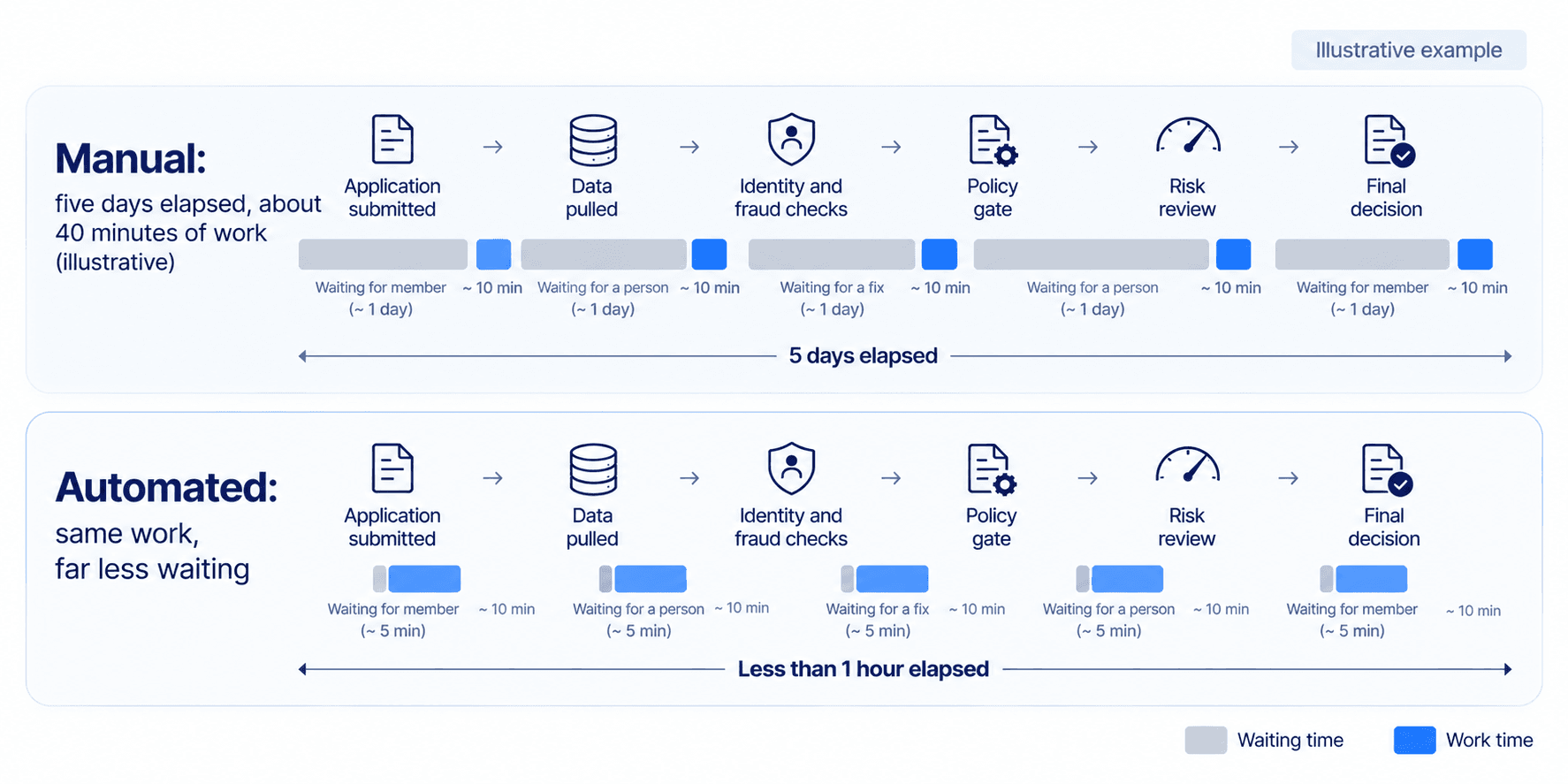
Every file runs on two clocks.
The work clock measures the minutes someone actually spends on it: reading the application, checking a document, making a call on the credit, typing a note.
The wait clock measures everything else: the hours a file sits in an inbox, the days it waits for a member to send a document, the afternoon it spends in line for a second review.
Here is an illustration. A typical manual file might need 40 minutes of real work and still take five days to fund. Those numbers are made up for the example, but the shape should feel familiar. Nearly all of the elapsed time belongs to the wait clock.
That's why working harder rarely helps. A processor who speeds up by 20 percent shaves eight minutes off a five day journey. Removing a two day wait for a missing paystub saves two days.
The waits tend to cluster in the same places:
- Waiting for the member. Missing documents, unclear requests, a second request for something that should have been asked for the first time.
- Waiting for a person. A file lands in a shared queue, and whoever is free picks it up, eventually.
- Waiting for a second opinion. Routine files line up behind complicated ones because the same reviewers handle both.
- Waiting for a fix. A dealer packet with a wrong date, a mismatched name, a missing page.
- Waiting for the last mile. Signatures, booking into the core, and funding all happen after the decision, and they often add days nobody tracks.
These are ordered the way most credit unions should tackle them: measure first, then fix intake, then documents, then decisions, then everything that happens after.
This one costs nothing and pays back immediately.
Pull 50 recent files, and for each one write down the timestamp at every stage: application received, first touch, documents complete, decision made, documents signed, funded. A plain spreadsheet will do.
Then look for the longest gaps. You will almost certainly be surprised. Many teams assume underwriting is the slow part and discover that the biggest delay is the two days between "application received" and "first touch."
You also need this baseline to prove anything later. If you cannot show where you started, you cannot show what changed.
Every time a person retypes something a member already told you, you spend minutes and create a chance for a typo.
The fix is simple in principle. The member enters their information once, and it flows into the file without anyone rekeying it. For existing members, much of it can arrive prefilled from what you already hold in the core, which also shortens the form they have to complete. Shorter forms mean fewer abandoned applications, so the same marketing spend produces more finished files.
It sounds minor. It isn't. Intake is where every later delay is born.
Paystubs, bank statements, tax forms. Asking for them, waiting for them, and checking them is the single biggest source of back and forth in consumer lending.
A better pattern is to let members share the data directly, with their consent, from the source. Instead of uploading a photo of a pay stub, a member connects an account, and verified income and cash flow information arrives in the file. No photo taken at an angle, no "can you resend a clearer copy," no staff member squinting at a PDF.
This is what Algebrik's partnership with Conductiv is built around: in place of manual document collection.
Be honest about the limits, though. Some members will not want to connect an account, and some situations (self employed income, cash heavy businesses) still need documents. Keep an upload path for them. The aim is for most members to skip the paperwork, not for any member to be blocked.
Even with better data, some files will need something. What happens next decides whether it takes an hour or a week.
In a manual process, a processor notices a missing item, sends a message, makes a note, and later checks whether it arrived. Multiply that by every open file.
An automated process does the following instead:
- Identifies everything missing on day one, and asks for it in one message, not five.
- Reads each incoming document and compares it to the application, so staff only look at the ones that disagree.
- Sends reminders on a schedule without anyone setting a calendar alert.
- Checks items off as they arrive and moves the file forward the moment it is complete.
Our piece on goes deeper on where these touchpoints sit.
One caution. Speed should never mean skipping scrutiny. Document checks and fraud screening belong in this same step, running automatically, so a forged pay stub gets flagged instead of waved through faster.
5. Let Software Decide the Clean Files
Here is where the most staff time comes back.
Most consumer loan applications are not close calls. The member has a clean history, verified income and a loan that sits comfortably inside policy. A person reviewing that file is not adding judgment. They are confirming the obvious.
Automated decisioning applies your credit policy to those files in seconds and sends the clear approvals straight through. Borderline files go to a lender, and the decision comes with its reasons attached. Your lenders stop spending the morning on easy files and spend it on the ones that benefit from their experience.
If you want the mechanics, we cover them in two places: , and
A few ground rules keep this safe:
- Your policy stays in charge. Automation applies your rules. It does not invent new ones.
- Keep a wide referral lane at first, then narrow it as the evidence builds.
- Make sure every decline can be explained in plain language. A model you cannot explain is a compliance problem, however fast it is.
Want to see what this looks like in a real lending workflow? You can and click through an application at your own pace. No sales call needed.
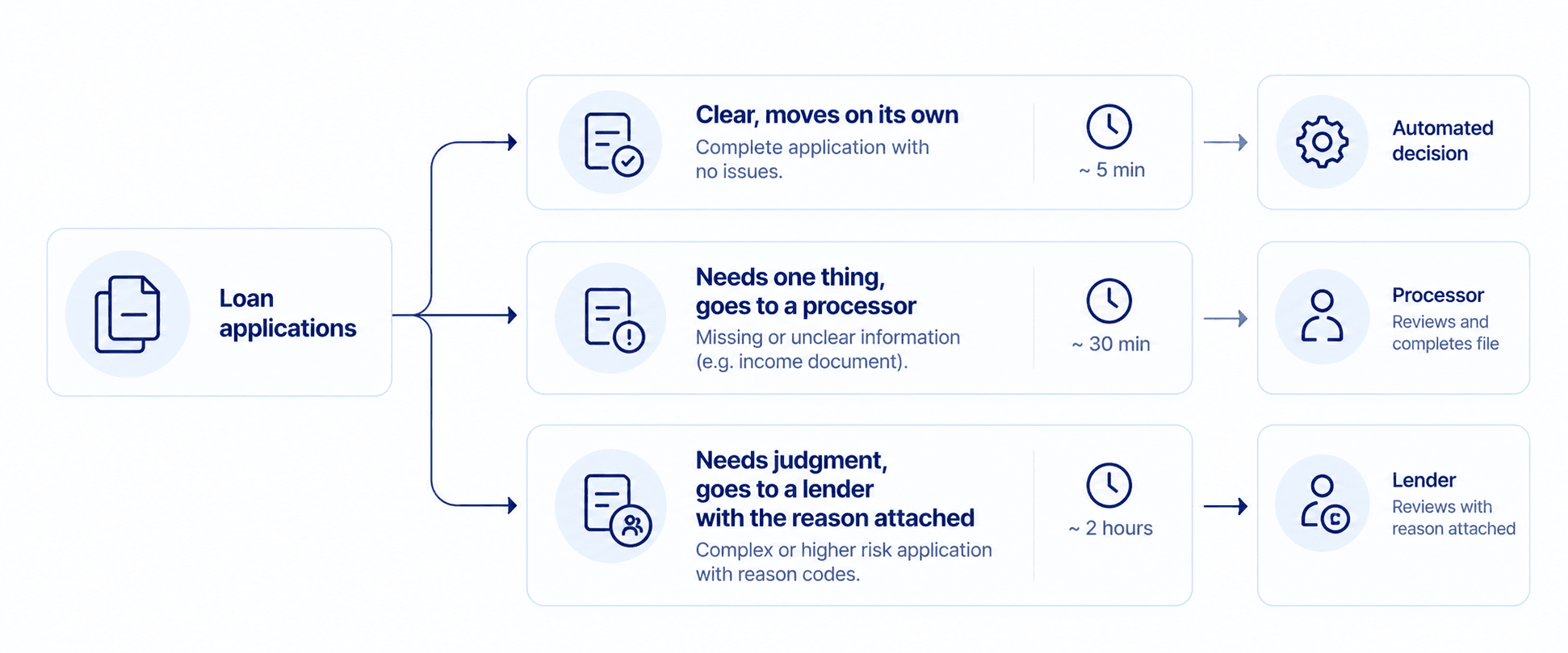
A single shared queue treats every file the same. A simple auto loan waits behind a complex self employed application, and the reviewer has no way to know which is which without opening both.
Sort files into lanes instead:
Lane one: clear. Complete, in policy, no flags. These move on their own.
Lane two: needs one thing. A single missing item or a minor mismatch. These go to a processor with the exact issue named.
Lane three: needs judgment. Unusual income, policy exceptions, a long standing member who falls just outside the lines. These go to an experienced lender, with the reason for the flag attached.
Two small additions make it work even better. Assign files by skill, so complex ones reach the people best placed to assess them. And put a visible timer on each lane, so a file that has been sitting too long gets noticed before the member calls.
This is also fairer. Two members in similar situations get similar treatment, rather than different outcomes depending on who picked up the file.
After the decision, a surprising amount of time disappears into signatures, booking and funding. And every hour of silence generates another phone call.
Automatic status messages fix the second problem. The member hears when the application arrives, when something is needed, and when the decision is made, and always knows the next step. That alone can cut the "where is my loan?" calls that interrupt your team all day.
On the first problem, electronic signatures, automatic hand offs into the core, and clear funding steps keep a decided file from stalling. Each of these is small, and together they can take days off the end of the process.
Our article on covers what members notice most. For indirect lending specifically, is worth a read, since dealer packets are one of the most common sources of delays.
Anyone who quotes you a single percentage without looking at your process is guessing.
What you can do is estimate your own capacity. Here is the arithmetic, with illustrative numbers:
Files per month × minutes saved per file ÷ 60 = hours freed per month.
Say you process 600 consumer loan applications a month, and automation saves 25 minutes of staff time on each one through less retyping, fewer document checks and no manual status updates. That is 15,000 minutes, or 250 hours a month. Divide by roughly 160 working hours in a month, and you have freed the equivalent of about one and a half full time roles, without hiring anyone. Swap in your own numbers and see what you get.
For a sense of what others report, a CU Insight article sponsored by a technology vendor described a $2.4 billion credit union that automated its indirect auto document handling. The credit union reported funders handling more than 20 deals a day, up from 10, a 30 percent cut in manual processing time, and a reduction from 6.4 to 2.8 full time equivalents for the same loan volume. These are vendor reported figures, with no independent verification or timeframe, so treat them as a direction of travel rather than a promise. Results depend on your starting point, your products and your data.
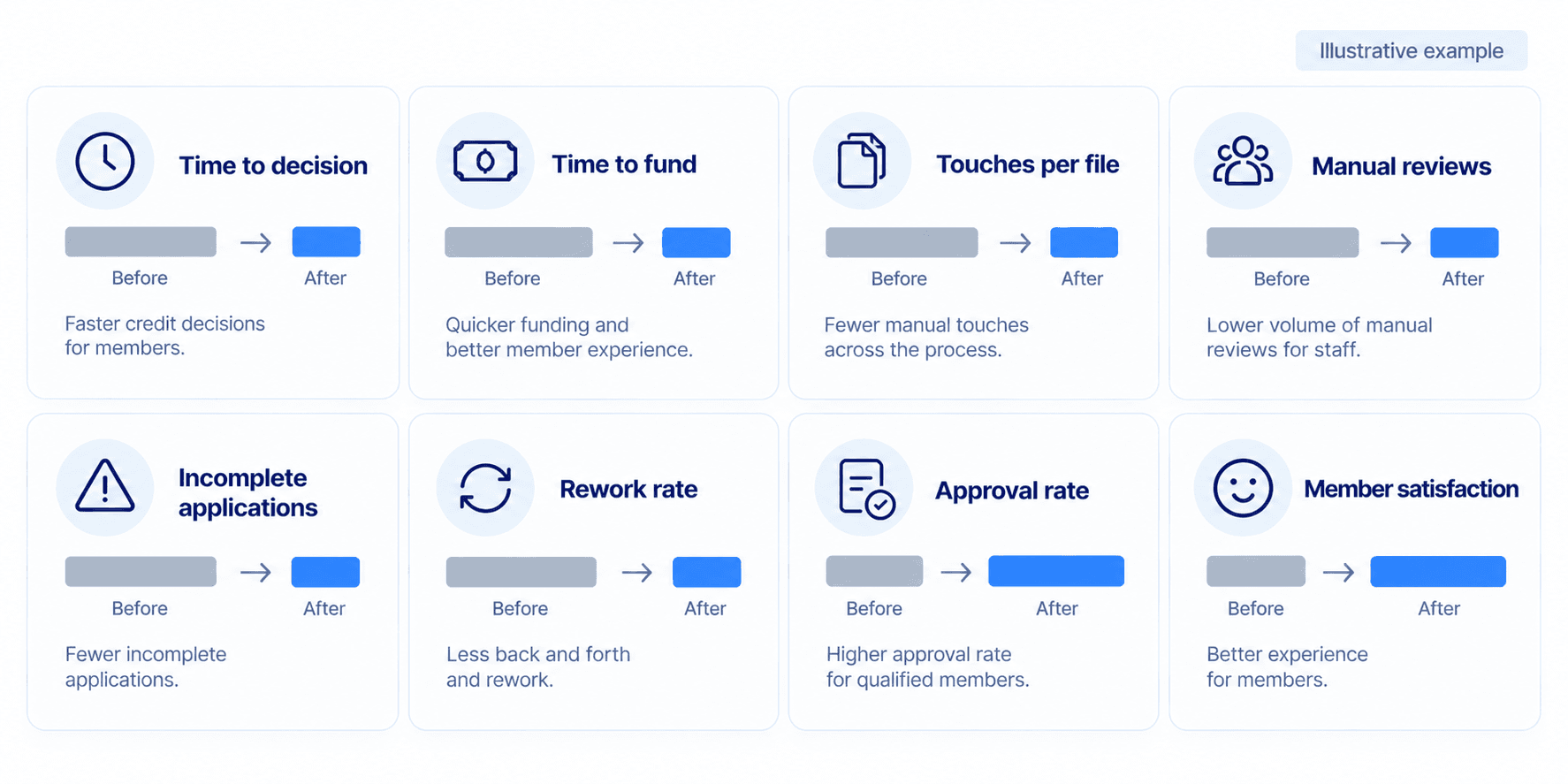
If you track only one thing, you will optimize it and break something else. A small scorecard keeps you honest:
- Time to decision. Application received to decision made.
- Time to fund. Application received to money out the door.
- Touches per file. How many times a human handled it.
- Automatic decision rate. The share of files decided without manual review.
- Stipulation cycles. How many rounds of "we still need something" each file takes.
- Application completion rate. The share of started applications that finish.
- Status calls per file. A quiet but honest measure of member anxiety.
- Override and referral rates. These tell you whether your automation is tuned well.
A few patterns come up again and again.
Automating a messy process. If your intake form is confusing or your policy lives in three people's heads, software will just make the confusion faster. Clean up the process first.
Buying one tool per stage. Separate products for documents, decisioning and messaging each create a new boundary for someone to carry information across. You can automate every step and still leave your team doing the coordinating.
Skipping the baseline. Without before numbers, there is no after story to tell your board.
Closing the human lane too early. Start with plenty of files going to people, then narrow the lane as trust and evidence grow.
Trading speed for control. Fraud screening, bias testing and clear reasons for declines stay in the workflow. Faster should never mean looser.
Forgetting the team. Staff who understand why the change is happening, and what it frees them to do, adopt it faster. Explain that the goal is to take the retyping off their plate, not to replace them.
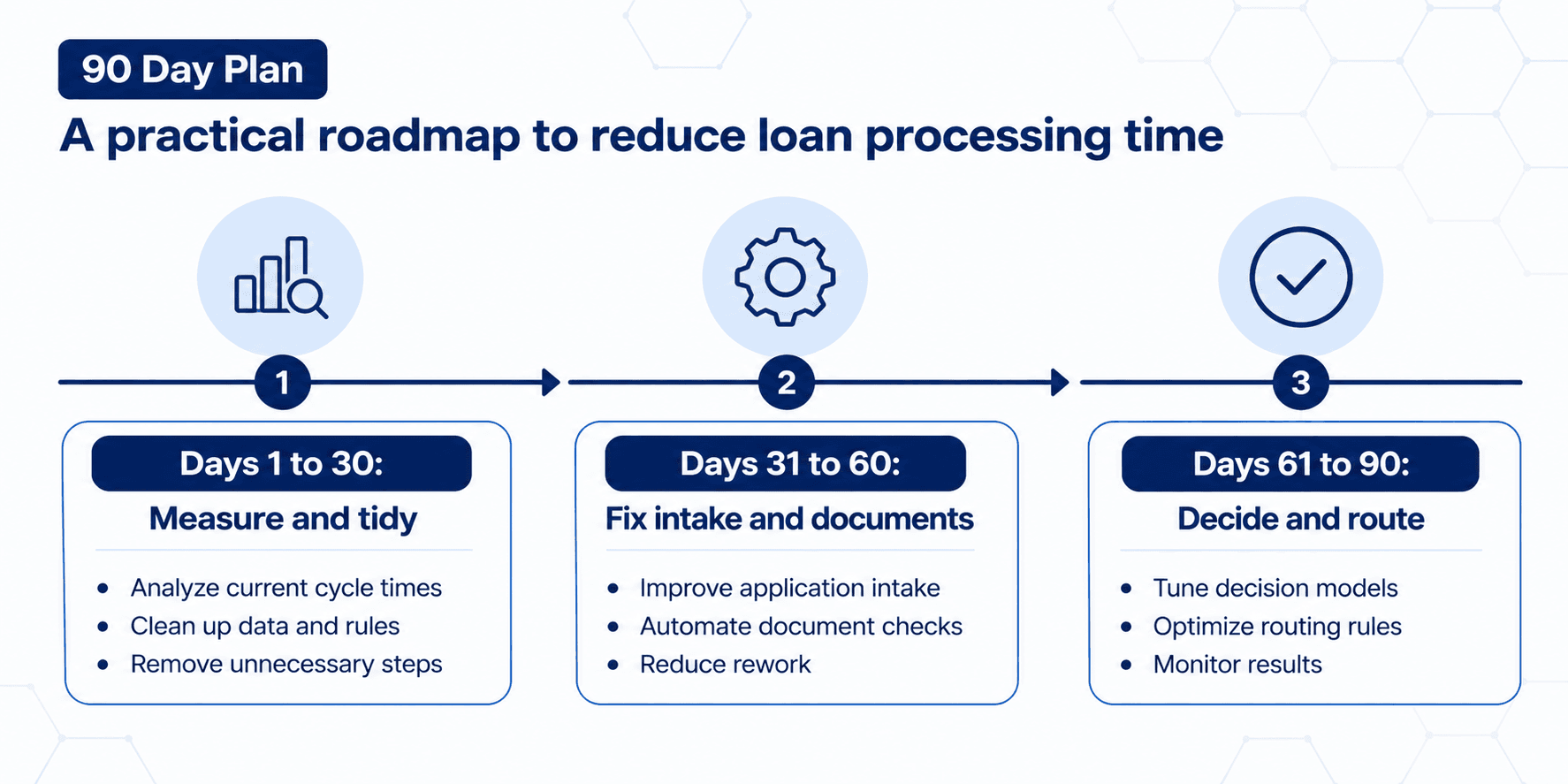
You do not need to flip every switch at once. A steady plan looks like this.
First 30 days: measure and tidy. Pull your 50 file sample, find the longest gaps, and write your credit policy down in one place. Pick one product to begin with, such as auto or personal loans, where volume is high and data is rich.
Days 31 to 60: fix intake and documents. Shorten the application, prefill what you already know, and move income and document collection to digital methods. Set up one consolidated request for anything missing.
Days 61 to 90: decide and route. Start scoring applications in the background without changing outcomes, then compare what the system would have done with what your lenders did. Set up your three lanes and your timers. Begin sending automatic updates.
After that, review the scorecard monthly and expand to the next product.
If you are choosing technology along the way, our lists what to look for before you buy, and helps you pick which projects deserve a pilot first.
Your team is probably not slow. They are working inside a process that makes files wait.
Measure where the waiting happens. Capture data once. Let members share documents and income directly. Automate the chasing. Let software handle the clean files. Route the rest by exception. Keep members informed without anyone writing the message.
Do those, in that order, and loans move faster, members feel it, and your existing team gets room to breathe.
If you would like to see how this plays out in a real workflow, at your own pace. And if you would rather talk through your own process, with real numbers,
Frequently Asked Questions
How can a credit union reduce loan processing time without hiring more staff?
By removing waiting instead of adding effort. Capture application data once, collect documents and income digitally, automate stipulation requests and reminders, let software decide clean applications, route exceptions to the right person, and send status updates automatically. Most elapsed time is spent in queues, so these changes shorten turnaround while freeing your existing team.
What causes slow loan processing at credit unions?
What should a credit union automate first?
How long should a consumer loan take to process?
Will automation replace loan officers or processors?
How do you measure loan processing time?
Does faster processing increase fraud or compliance risk?
Ready to get started?
More Blogs

Blog
Computerized Loan Origination: How Technology Transformed Lending

Blog
Loan Origination System Requirements: A Checklist Before You Buy

Blog
Consumer Finance Systems: Why Unified Platforms Win Over Fragmented Stacks