 ‹ All Blogs
10 Features to Look for in a Modern Loan Origination System
Ask a loan officer what a normal Tuesday looks like and "processing loans" is ra...
Ask a loan officer what a normal Tuesday looks like and "processing loans" is rarely the honest answer. The real version sounds more like this: retyping the same borrower details into three screens, phoning an applicant because a pay stub scanned badly, and digging through an email thread to work out why a file got flagged last week.
None of that is a people problem. It is a systems problem, and more and more often it is a loan origination system (LOS) problem.
For years, an LOS was simply software that pushed an application from one queue to the next. That was fine when lending ran on paper and phone calls. It is not fine now. Today the LOS sits in the middle of the whole lending relationship: applications, documents, decisioning, communication, compliance and funding. When it cannot connect those pieces by itself, your staff end up doing the connecting by hand.
So what separates a capable, current generation LOS from one that merely happens to run in the cloud? Here are ten features to put on your shortlist.
A quick heads up before we start. Algebrik publishes this blog, so two sections include a short "See it in practice" note showing how its own platform handles that feature, and the end offers a walkthrough of the platform. Skip them if you like. Each ends with something to watch for in any vendor demo, Algebrik's included.
A loan origination system is software that helps banks, credit unions and other lenders manage a loan from application through decisioning and funding. Depending on the platform, it can also cover document collection, identity and income verification, underwriting, compliance steps, borrower communication and reporting.
The distinction that matters: a modern LOS is not a digital filing cabinet for paper forms. It moves data between stages on its own, so employees stop carrying it from step to step. For lenders, that usually means less administrative drag on staff and a calmer experience for the person applying.
Trace everything that happens after someone hits submit. Details get validated. Documents get collected and reviewed. Identity and eligibility get checked. Credit gets pulled and evaluated. A decision gets made, the applicant needs an update, and an approved loan has to travel toward closing and funding.
When those steps live in separate systems, an employee becomes the glue: copying data, forwarding emails, updating spreadsheets so nothing slips. A capable LOS moves work along without that help. It should trigger the right next step based on the application, the product or the outcome, rather than waiting for a person to nudge it.
The payoff is not only speed. It is consistency. The same kind of application gets handled the same way whether it is the first of the day or the fiftieth.
Borrowers do not think in channels. They think about getting a loan. Someone might start on a phone during lunch, resume on a laptop that evening, talk it through with a loan officer the next day, and sign paperwork in a branch.
A current LOS needs a point of sale experience that holds up through all of it, digital, branch and loan officer assisted, without making the applicant start over at each switch. For credit unions this matters even more, because technology should strengthen the member relationship rather than sit between the member and the institution as one more hoop. Auto lenders and banks hit the same wall in other forms: a buyer who begins financing at the dealership should not have to redo everything when they finish from home.
Done well, it also spares staff duplicate entry, because whoever picks up the file can see exactly where the applicant stopped.
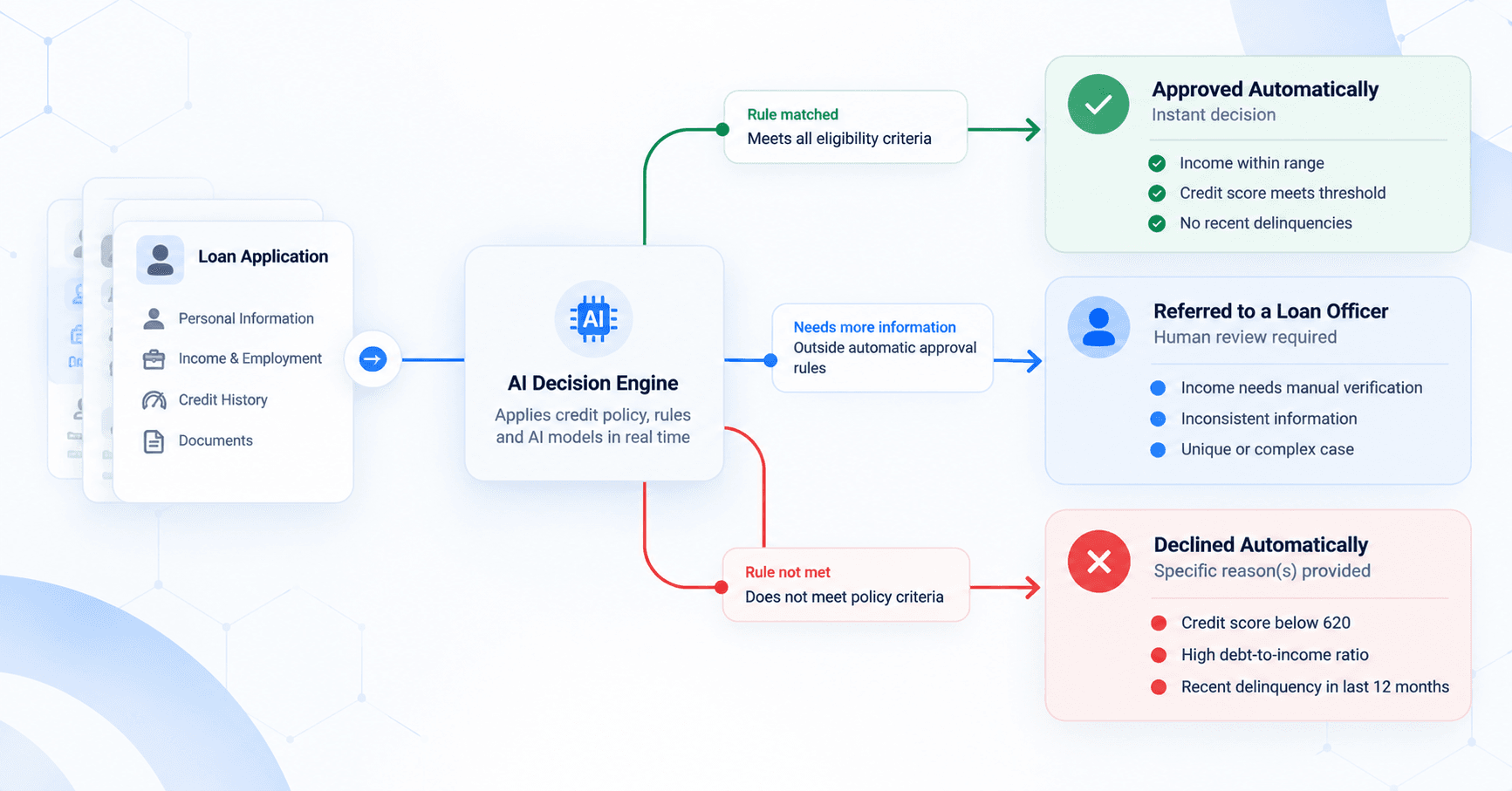
Decisioning is where lending technology is moving fastest, and also where it is easiest to feel nervous. The point is not to hand every credit call to a model nobody can explain. It is to apply a lender's own credit policy consistently, clear the genuinely repeatable decisions automatically, and route the harder ones to a person.
A good engine applies your policies as written, draws on the data sources you actually trust, clears straightforward approvals and declines on its own, sends exceptions to the right reviewer, and leaves a clear trail explaining what it did and why.
That last part is not optional. ECOA and Regulation B require lenders to give a denied applicant the specific reasons, and using a complex or machine learning model does not change that. The CFPB spelled this out for algorithmic models in a 2022 circular, which it withdrew in May 2025 as part of a broad cleanup of guidance. The law underneath did not change, though, and applicants and state authorities can still enforce it. In practical terms: if a model cannot say why it weighted one factor over another for a particular applicant, it cannot produce a compliant denial notice.
So the sharper question is not how smart the model is. It is whether your staff can understand, govern and defend each decision in terms a regulator, and a declined applicant, would accept.
See it in practice: AI Decision Engine Algebrik's Decision Engine lets credit and risk staff build approval logic, pricing bands and eligibility flows visually, with no code. Strategies can be tested against past applicants before launch, and two rule sets can run side by side in a champion challenger test. The company says each decision is logged with full traceability, and a confidence score sends borderline cases to a person instead of forcing a call.
What to watch for: open a decision record and see whether you can tell which rules fired, in plain enough language to put in a denial notice. or read more on the .
Pay stubs, bank statements, tax forms, IDs, proof of income: lending runs on paperwork, and somebody still has to pull the right numbers out of it. A capable LOS carries a good chunk of that load. It should:
- Extract the relevant fields automatically
- Compare them with what the application says
- Flag what is missing before it turns into a delay
- Send the file wherever it needs to go next
None of this removes judgment. It means underwriters and loan officers spend time on the documents that deserve a second look instead of every document, every time.
No LOS works alone. Most lenders already run a core banking system, credit bureau relationships, identity and income verification, fraud tools, pricing data and electronic signatures, and none of it disappears because you bought new origination software.
That makes integration closer to a dealbreaker than a nice extra. The better question for any vendor is not "what features do you have" but "does this fit what we already run, or are we buying another silo with its own workarounds?" A platform that connects through open APIs and prebuilt connectors answers that more convincingly than a sales deck.
Products shift. Credit policy shifts. Compliance requirements shift. If every one of those changes means opening a ticket with engineering and waiting six weeks, your LOS is setting the pace of your business, and it should not.
A platform that deserves your budget hands lending and business staff real control over workflow configuration and rules, with no developer in the loop for routine changes. That matters most when you want to try a new product or tighten a policy and see the effect quickly, instead of planning it a quarter ahead.
Once an application is in, silence creates friction. Did you get my documents? What is still missing? How much longer will this take? A good LOS answers those questions by itself: status updates, document requests and next step notices going out automatically, timed to where the file actually stands.
Done properly, this does not make lending feel less personal. It does the opposite. It clears out the repetitive messaging so the conversations your staff do have with borrowers and members are the ones that needed a person in the first place.
Loan applications carry some of the most sensitive information a person ever hands an institution: income, identity, credit history, sometimes months of bank statements. Look for real access controls, audit trails, role based permissions, secure integrations and reporting that survives an exam, not a checkbox on a slide.
This matters more, not less, once AI is involved. NCUA has not issued a standalone AI rule, and its 2026 supervisory priorities letter centers on lending risk, fraud and payments, and BSA and AML compliance rather than naming AI. That does not make AI a no look zone. Examiners still review vendor management, fair lending and operational risk, and because NCUA has no direct authority to examine technology vendors, the diligence falls on the credit union. A platform that can answer those questions for you, instead of leaving you to reconstruct the answers mid exam, is worth more than its feature list suggests.
A lending team should not wait for a month end report to learn where applications are stalling. Look for live visibility into:
- Application volume, approval and decline rates
- Processing and funding times
- Abandonment, meaning where applicants drop out and at which step
- which products are gaining or losing ground
The dashboard itself is not the value. The value is answering a specific question the moment it comes up, instead of waiting for somebody to pull a report.
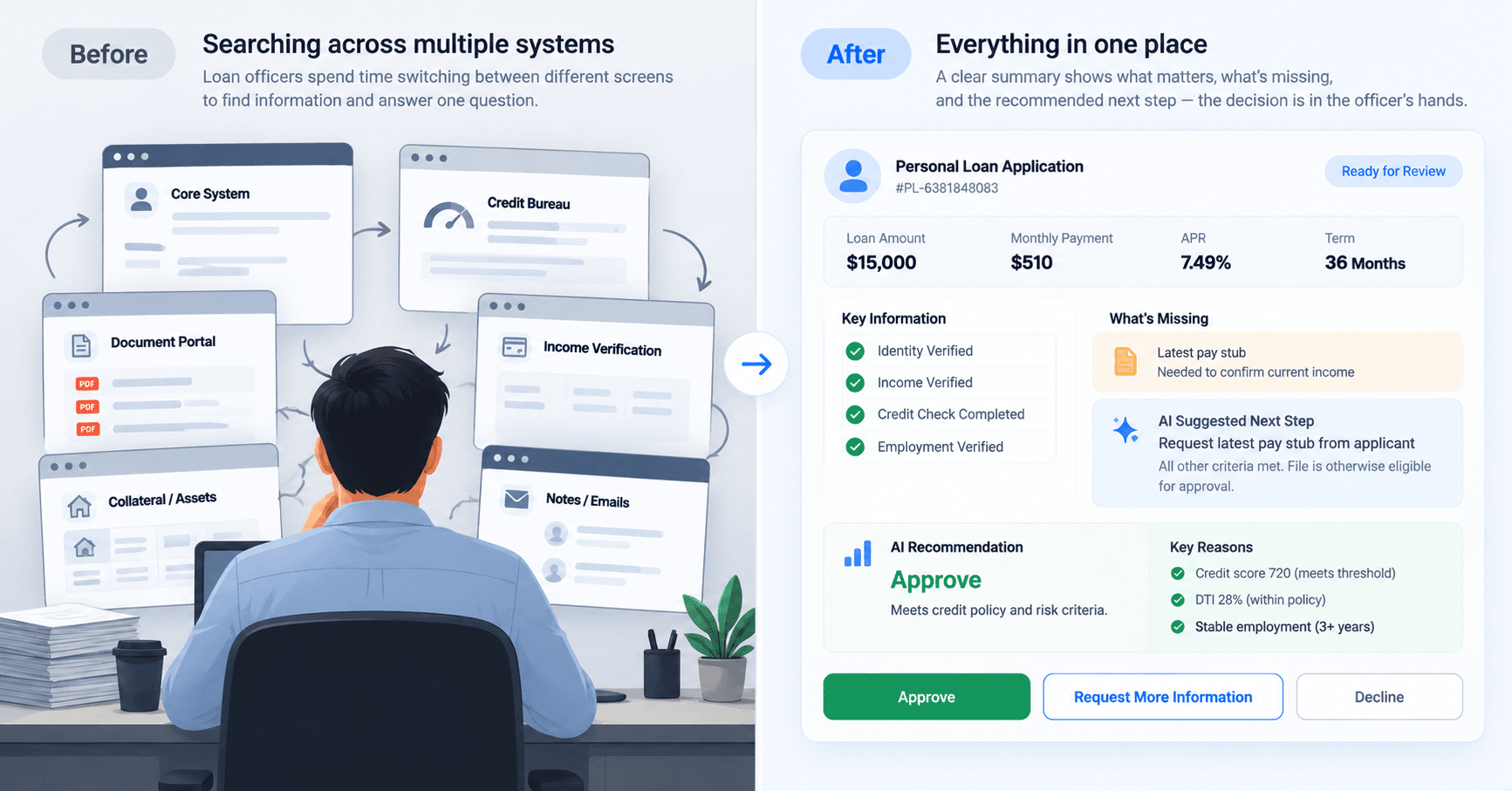
Everything so far treats AI as a decisioning tool. It can do more. Inside the workflow itself, AI can summarize an application, flag what is missing, surface what an underwriter needs to see next, and cut the administrative digging that eats into a loan officer's day.
The version that justifies its price does not feel like "using AI." It feels like getting through the queue faster, because the system already did the part that used to mean five minutes of hunting across screens.
See it in practice: Lender's Cockpit Algebrik's Lender's Cockpit gives loan officers one priority sorted queue with recommended next steps, in app messaging with borrowers, and files that can be shared with a credit analyst without an email thread. Inside it, AI Takeover completes the rule driven tasks and offers confidence scored recommendations on the judgment calls, leaving the final decision with the loan officer. The company's internal benchmarks cite more than 20 minutes saved per file.
What to watch for: notice who holds the decision. A good assistant recommends and explains, and the officer stays in charge. , or read more on the .
A feature list only goes so far, and every vendor can produce one. What separates a connected platform from one still leaning on spreadsheets and side emails comes down to a handful of honest questions:
- Does it cover the whole journey, or just intake?** Ask what happens after the application is submitted, not only how it arrives.
- How much manual work genuinely disappears?** Not "automation" as a word on a slide, but which specific tasks stop needing a person.
- Can your own staff configure it,** or does every change need a developer and a ticket?
- Does it fit what you already run,** or does it ask you to rebuild around it?
- How is AI governed?** Can decisions be explained, monitored and defended to an examiner?
- Does it improve the experience on both sides,** for the person applying and the person processing?
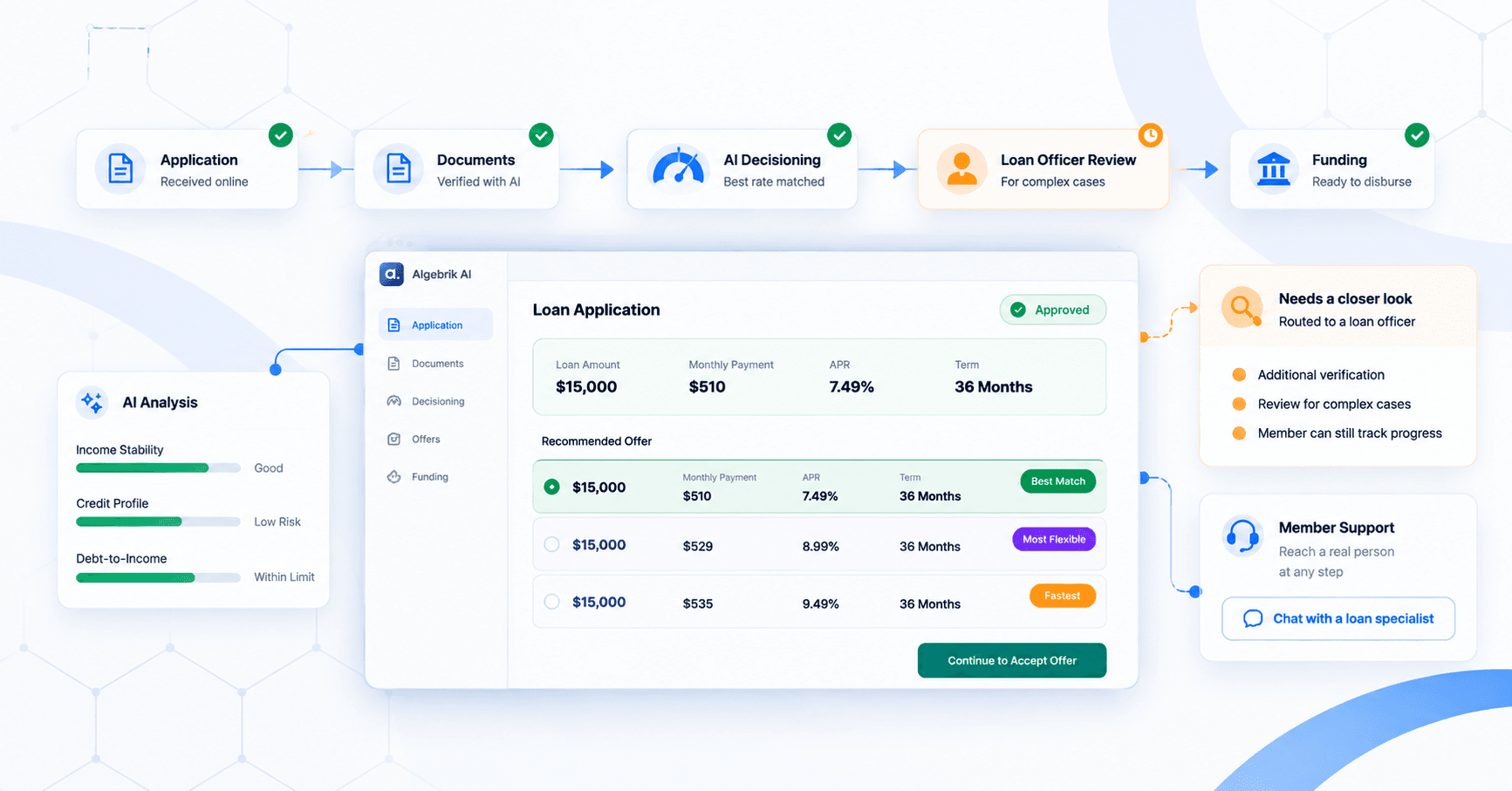
Everything above is easier to judge when you can click through it. So here is the short version of Algebrik One, the platform behind this blog, laid out in the order a loan actually travels. Each stop connects back to features you just read about.
Stop 1: Apply. Omnichannel POS and Digital Account Opening let applicants begin on any device or in a branch, and the company says members can open an account in under three minutes. A Smart Prefill Engine uses existing data to fill in fields so nobody retypes them.
Stop 2: Check. An AI Identity Verifier reviews member documents and KYC signals using image recognition and pattern matching, flagging anomalies as they appear, while document processing reads and cross checks the paperwork.
Stop 3: Decide. The [Decision Engine](https://algebrik.ai/solutions/decisioning/) applies your credit policy, scores in real time and escalates borderline cases based on confidence, with policy changes made by business users rather than developers.
Stop 4: Work the file. The [Lender's Cockpit](https://algebrik.ai/solutions/lender-cockpit/) keeps tasks, borrower messaging and AI recommendations in one workspace, so a loan officer is not hopping between a CRM, the core and an inbox.
Stop 5: Fund and learn. Disbursement happens with a single click, and Portfolio Analytics feeds results back in. A Predictive Risk Monitor watches for early delinquency signals, and an AI Performance Loop retrains models on actual outcomes.
Underneath all five, role based governance and automated rule logs keep a record of what happened and who allowed it, which is exactly what an examiner will ask to see.
- How many screens, and how many logins, a single loan touches
- Where the system hands a decision to a person, and what it shows them when it does
- How a denial reason gets produced, in plain words
- How long a policy change takes, and who is allowed to make it
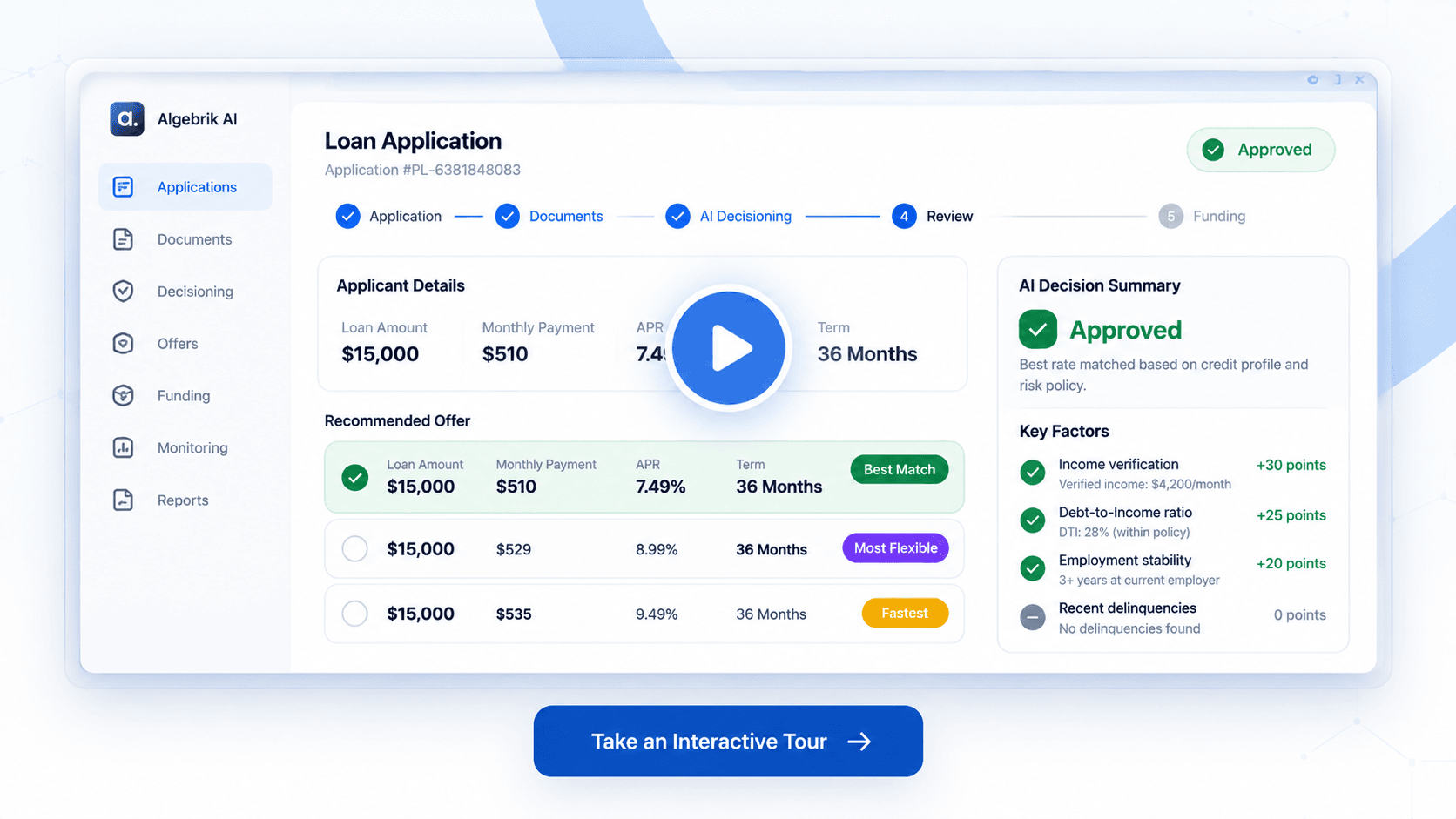
and click through at your own pace.
None of this is really about counting features. It is about whether a platform helps you originate loans faster, run leaner and adapt as products and regulations change, without turning each change into a project.
That is the problem Algebrik built its loan origination suite around: one AI powered, cloud native platform connecting digital account opening, document processing, point of sale, borrower communication, AI decisioning, member verification, application management, portfolio analytics and AI lender enablement into a single continuous process for credit unions, banks and auto lenders alike.
The system you pick should not make lending more complicated. It should take the parts that already are complicated and make them easier to manage, so your staff spend less time reconciling systems and more time on the part of the job that still needs a person: understanding the borrower in front of them.
Frequently Asked Questions
What is the difference between an LOS and a modern LOS?
Both move a loan from application to funding. A modern LOS connects those steps on its own, while an older one leaves employees to bridge the gaps with manual work and duplicate entry.
Does AI in an LOS replace loan officers?
What should credit unions watch for in a loan origination system?
How should a lender evaluate a vendor's AI governance?
Can I see a loan origination system demo before talking to a salesperson?
Which integrations matter most in a loan origination system?
Ready to get started?
More Blogs

Blog
Computerized Loan Origination: How Technology Transformed Lending
Blog
Loan Origination System Requirements: A Checklist Before You Buy

Blog
Consumer Finance Systems: Why Unified Platforms Win Over Fragmented Stacks