 ‹ All Blogs
How Does AI Credit Decisioning Work for Credit Unions?
The short answer: AI credit decisioning works by feeding a member's application,...
The short answer: AI credit decisioning works by feeding a member's application, credit bureau data and verified income into a trained model that estimates how likely the loan is to be repaid. The credit union's own policy rules then turn that estimate into an outcome: approve, approve with different terms, refer to a lender, or decline. Every outcome is logged with its reasons. Done well, clean applications get an answer in seconds, and your lenders spend their time on the files that actually need a human.
It's a Sunday night, a little before ten. A member is on the couch with her phone, applying for a $14,000 auto loan. She has been with your credit union for nine years. Her paycheck lands on the same day every two weeks. She has never missed a payment on anything.
In a traditional setup, her application waits until Monday morning. A lender pulls the score, checks the debt to income ratio, scrolls through the bureau file, makes a call, and sends a message. By then she has already texted the dealer's competitor lender "just in case."
With AI credit decisioning, she puts the phone down and the answer is already there. Nobody was awake. Nobody needed to be.
That's the pitch. But if you're a chief lending officer or a risk lead, you don't sign off on pitches. You sign off on mechanisms. So let's open the hood and look at how this actually works, what it needs from you, and where it can go wrong.
Because credit unions have moved from curious to committed.
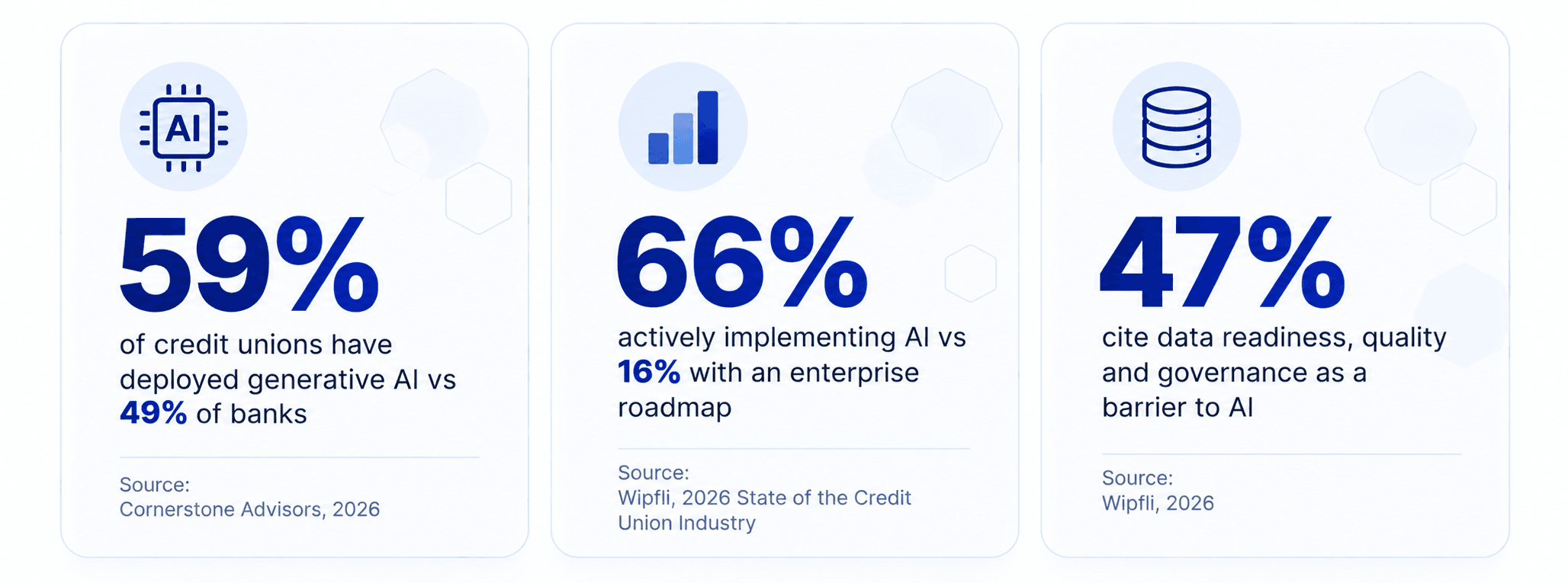
Two industry surveys tell the story. Cornerstone Advisors’ 2026 research, based on 416 bank and credit union executives, found that 59 percent of credit unions have already deployed generative AI, ahead of 49 percent of banks. Wipfli’s 2026 State of the Credit Union Industry report, which surveyed 100 credit union executives in fall 2025, adds the catch: 66 percent are actively implementing AI in targeted areas, but only 16 percent have an enterprise wide roadmap for it. And 47 percent of those executives listed data readiness, quality and governance as a barrier, which matters a lot here, because a decisioning model is only as good as the data it can see.
Read those together and the picture is pretty clear. Plenty of credit unions have decided to do this. Far fewer have worked out how, in what order, and with what safeguards. That gap is the reason this explainer exists.
AI credit decisioning is the use of machine learning models inside the lending workflow to assess credit risk and recommend, or make, a decision on a loan application. It sits on top of your credit policy and does not replace it.
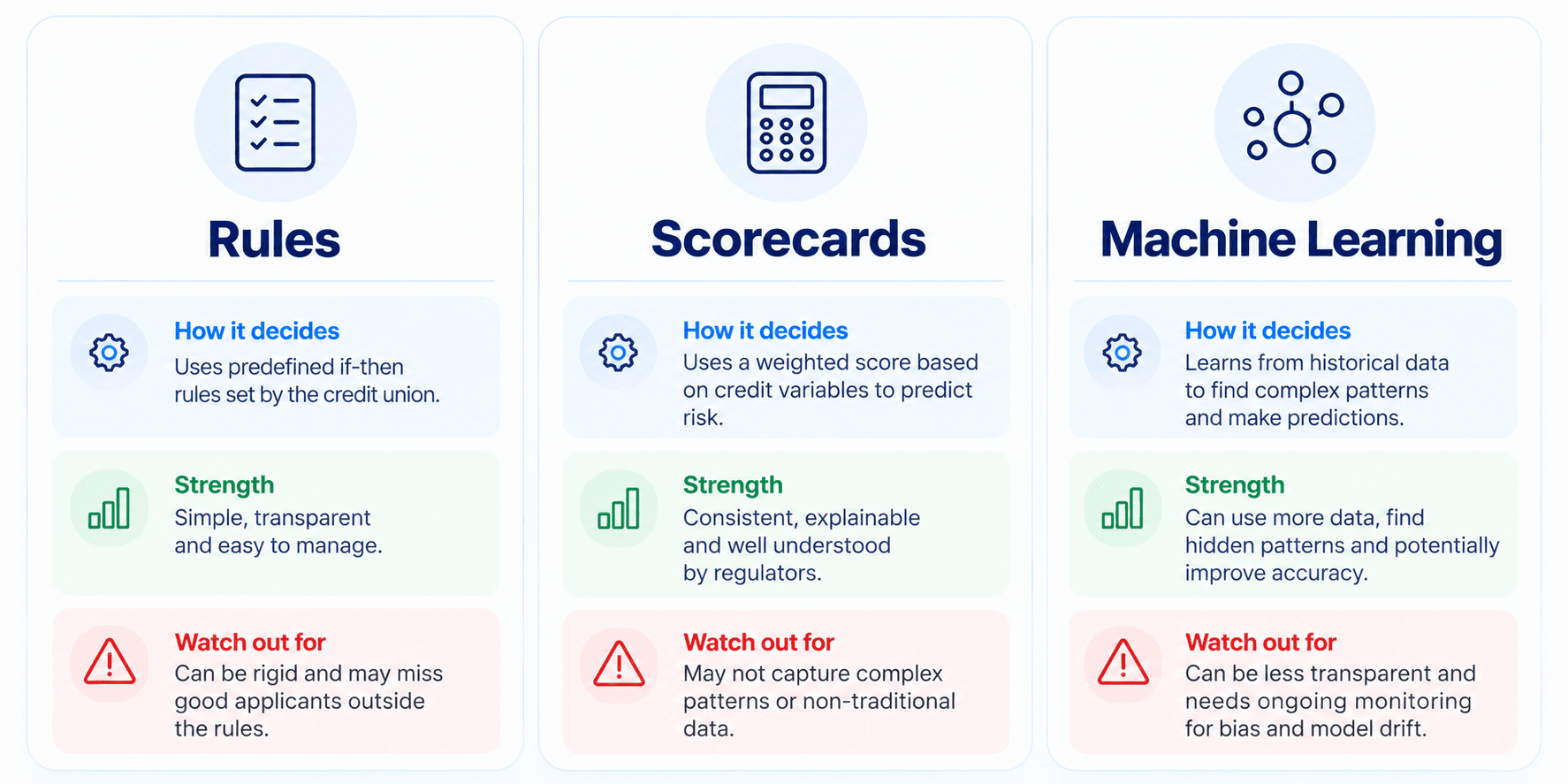
To see what the "AI" part adds, it helps to know the three engines lenders have used over the years.
Rules. The oldest approach. If the score is below 640, decline. If the debt to income ratio is above 43 percent, refer. Rules are easy to read and easy to audit, but they judge each factor on its own. They can't tell the difference between a 44 percent ratio on someone with a rock steady job and growing savings, and a 44 percent ratio on someone who started a new job last month.
Scorecards. A scorecard gives points for different attributes and adds them up into a single number, which maps to a decision tier. FICO scores work this way. Scorecards have a long compliance track record, but they're mostly static, and they only use the variables someone built into them years ago.
Machine learning models. Instead of a fixed list of points, a model learns from your past loans which combinations of signals tend to go with repayment and which tend to go with trouble. It weighs hundreds of data points together, including how they interact. Many credit models use techniques such as gradient boosted trees, which are collections of small decision trees voting on one answer.
Here's an easy way to hold the difference. A rule is a checklist. A scorecard is a checklist with a calculator. A machine learning model is closer to a veteran lender who has seen a million files and has a feel for which combinations matter, except it can explain, number by number, how it got there. We'll come back to that part, because it's the part examiners care about most.
Most credit unions don't pick one engine. They combine them: rules set the hard floors and policy limits, and the model works inside them. Our guide to goes deeper on how the three compare if you want the side by side.
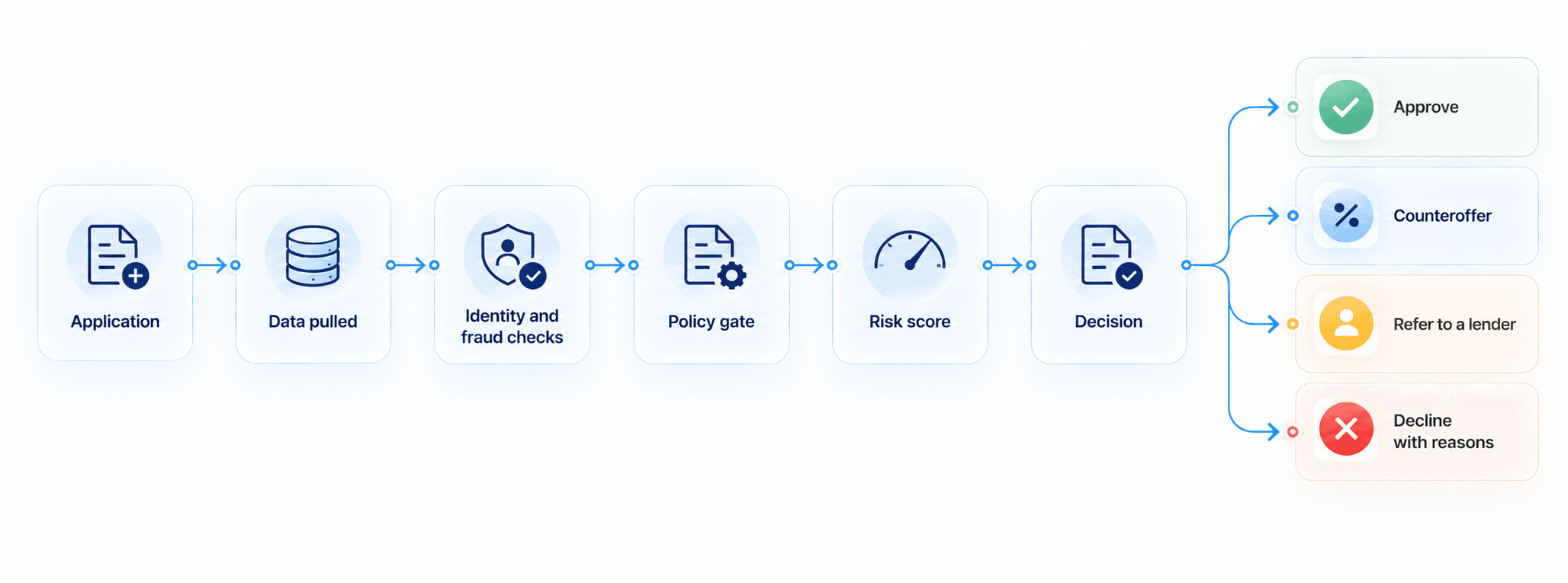
Let's follow one application through the engine. The whole sequence usually takes seconds, though the exact time depends on which data sources you call.
1. The application arrives and gets cleaned up. Income, employment, requested amount, vehicle or collateral details. Anything the member typed gets standardized, and obvious gaps get flagged right away so they can be asked for in one message instead of five.
2. The system pulls in outside data. Credit bureau reports, often including trended data that shows how balances and payments have moved over time. Verified income or bank account data if the member consents. Collateral values for secured loans. And your own history with that member, which is something no outside lender has.
3. Identity and fraud signals run first. Before the model estimates repayment, you want to know the applicant is real and is who they say they are. A synthetic identity can look like a great borrower on paper, so these checks come ahead of the risk score.
4. Policy rules act as the gate. Hard limits come into play: minimum membership requirements, maximum loan to value, regulatory exclusions. Anything outside those lines gets routed accordingly, regardless of what a model might say.
5. The model scores the risk. The model combines everything it can see and produces an estimate, typically a probability that the loan will go bad. It isn't a verdict yet. It's a number with context.
6. A decision strategy turns the number into an outcome. Your credit team sets this part. A low risk score might mean instant approval at a certain rate. A middle score might mean approval with a larger down payment, a shorter term or a co signer. A borderline score goes to a lender with the reasons attached. A high risk score becomes a decline, with the reasons recorded.
Notice what's happening in that last step. The model estimates. Your policy decides. That separation is what keeps your lending team in charge of credit strategy instead of handing it to a black box.
More than a traditional score does, but not everything under the sun. Typical inputs include:
- Bureau data. Payment history, balances, utilization, inquiries, and trended behaviour over time.
- Application data. Stated income, employment, the amount and purpose of the loan.
- Verified income and bank data. Pulled directly with member permission, so the model isn't relying only on what someone typed.
- Alternative payment data. Rent, utility and phone payment histories, which can help separate members who are building stability from those who are genuinely risky. Credit unions working on thin file lending have started using these signals.
- Collateral data. Vehicle valuations and loan to value for secured loans.
- Your own member data. Years of membership, deposit behavior, past loans with you.
That last item is the quiet advantage credit unions have. A bank across town can't see that a member has kept the same direct deposit for nine years and never overdrawn. You can.
Here's the honest caution, though. If your data lives in six systems that don't talk to each other, or key fields are missing or inconsistent, the model will struggle. Nearly half of the credit union executives Wipfli surveyed named data readiness as a barrier to AI.
It learns the same way a new lender does, just much faster: by studying outcomes.
The model is trained on historical loans along with what happened to them. Which ones were repaid on time, which went delinquent, which charged off. It looks for patterns across all the inputs and learns which combinations tend to precede trouble. Once trained, it applies those patterns to new applications.
Two practical consequences follow from that.
First, the model is only as fair and as accurate as the history it learned from. If past lending left out whole groups of members, the data will carry that gap. This is why testing for bias isn't a nice extra. It's part of the build.
Second, a model needs to be watched after launch. Economic conditions shift, member behaviour shifts, and a model that was sharp last year can drift. Good programs monitor how well the model's predictions match what's actually happening, and retrain or adjust when they don't.
This is the question that separates a defensible program from a risky one.
When a lender declines an application or offers worse terms, the Equal Credit Opportunity Act and Regulation B (12 CFR 1002.9) require a notice that gives the applicant the specific principal reasons. A vague line like "did not meet our standards" doesn't cut it. The Reg B commentary also suggests that listing more than four reasons is unlikely to help the applicant.
Machine learning models can be tricky here, because they weigh so many things at once. The usual answer is explainability tooling. Methods built on Shapley values, often called SHAP, estimate how much each factor pushed one specific applicant's score up or down. The strongest negative factors become the principal reasons: a high debt to income ratio, a short credit history, a recent late payment.
A quick note on the regulatory ground, because a lot of older content gets it wrong. The CFPB's 2022 and 2023 circulars on complex algorithms and adverse action notices were withdrawn in May 2025 as part of a broad rollback of guidance. That did not change the law underneath. ECOA and Regulation B still require specific reasons, and a model you can't explain still leaves you unable to write a compliant notice. If anything, with federal supervision in flux, the scrutiny has moved toward states, private litigation and your own examiners.
So the test for any AI credit decisioning setup is simple. Pick a declined application at random. Can your team say, in plain language, why the system reached that outcome, and can you prove the reasons on the notice match what the model actually used? If yes, you're in good shape. If not, don't go live.
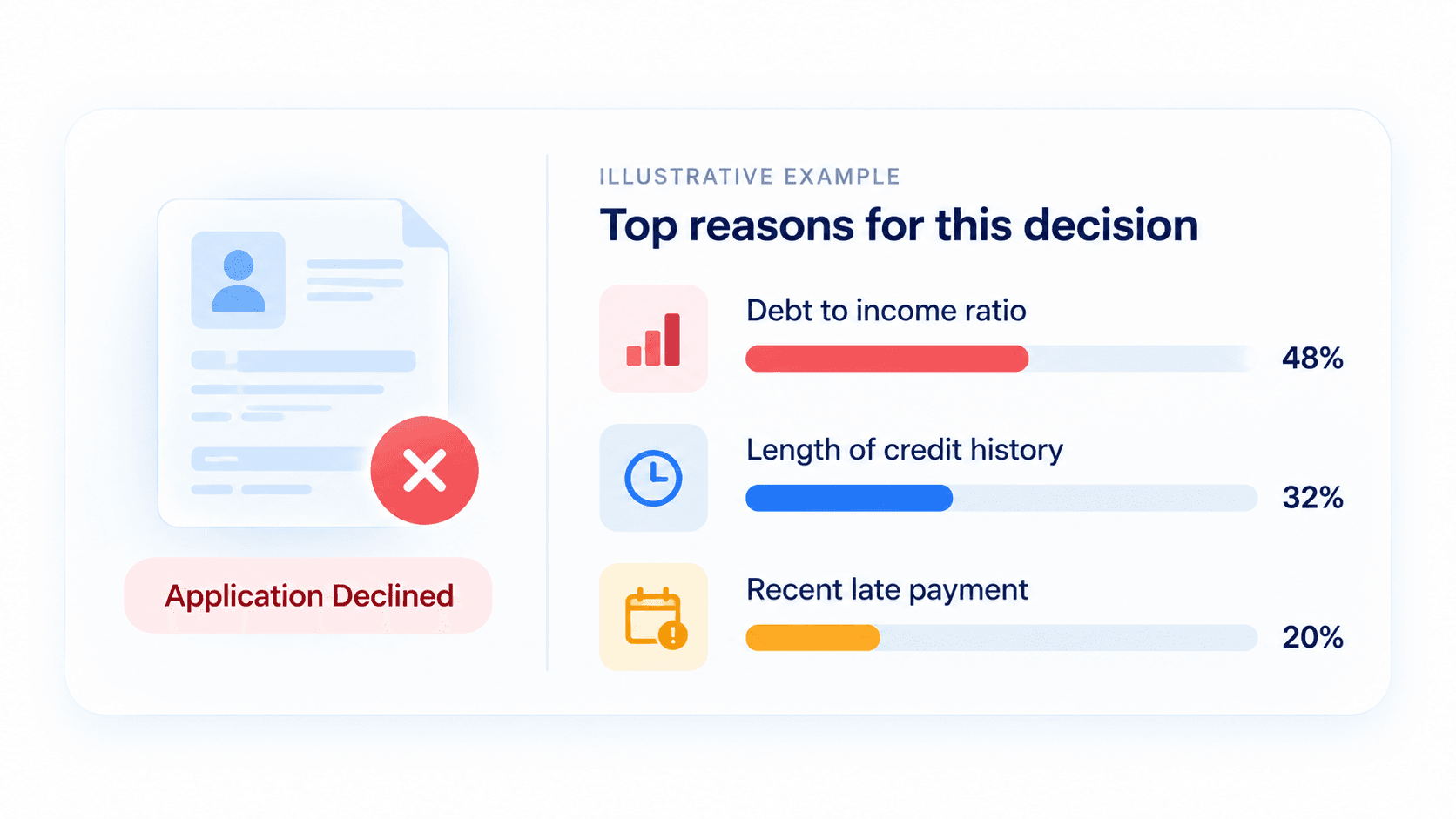
Want to see what a decision with reasons attached actually looks like in a working platform? You can and click through it at your own pace, no sales call needed.
Everywhere that matters.
Think of the outcomes as three lanes. The clear approvals move through on their own. The clear declines move through with recorded reasons. And the middle lane, the referrals, goes to a lender who sees the file, the model's view and the reasons together. That middle lane is where a credit union's mission lives. It's the member whose numbers are a little off policy but whose story and history say yes.
Two practices keep this honest.
Overrides with a paper trail. Lenders should be able to override a recommendation, and every override should be logged with a reason. Patterns in overrides tell you where the model or the policy needs work.
Champion and challenger testing. You keep your current approach as the "champion" and run a new model as the "challenger" on live applications without letting it decide. Then you compare the results before anything changes. It's the careful way to improve a model without gambling on it. Our article on explains how champion and challenger testing and supervised AI fit together.
Here's where it gets practical, because "will this pass an exam" is usually the second question after "does it work."
NCUA has not issued a standalone AI rulebook. Its published position is that it supervises AI within its existing framework, with the focus on risk management rather than the tool itself, and its January 2026 Supervisory Priorities letter named AI oversight as an examiner focus. In practice, examiners fold AI questions into vendor management, fair lending and operational risk.
There's one more wrinkle worth knowing. A May 2025 report from the Government Accountability Office found that NCUA's model risk management guidance lacks the scope and detail the other banking regulators provide, and that NCUA can't examine technology service providers, even though credit unions increasingly rely on them for AI. As of March 2026, GAO said NCUA's new AI resources page still doesn't provide detailed model risk management guidance, so the recommendation remains open.
What does that mean for you? Less detailed guidance from the regulator means more responsibility lands on your own due diligence. A sensible credit union has these ready:
- An inventory of where AI influences a lending decision.
- Documentation of how the model was built, tested and validated.
- Bias and disparate impact testing results.
- A monitoring plan, with who reviews it and how often.
- Vendor due diligence files, including what the vendor will and won't share about the model.
- Board approved policy on AI use, with a named owner.
If you're weighing vendors against that list, Our guide on lays out the questions to ask, including explainability and governance.
Be careful with anyone who quotes you one magic percentage. Results depend on your products, your data and your policy.
For a sense of scale, CU Insight reported that Centris Federal Credit Union, a Nebraska credit union with about $1.3 billion in assets, saw its share of automated loan decisions rise from 43 percent to 63 percent after adopting AI underwriting in 2024. The article adds that the model can identify applicants who might be overlooked because of thin or missing credit files. Treat that as a reported result rather than a benchmark: the article promotes the technology vendors involved, and no two institutions start from the same place.
The more reliable way to think about outcomes is in three buckets:
- Speed. More applications decided in seconds, fewer waiting in queues.
- Access. Fewer members declined because of missing data rather than real risk.
- Capacity. Your lenders spend their day on judgment calls and member conversations instead of routine files.
Measure your own baseline before you start, or you won't be able to prove any of it later.
It's not magic, and it fails in predictable ways.
- Bad or missing data. Garbage in, confident garbage out.
- A model nobody can explain. Great accuracy means little if you can't write the notice.
- Drift. The world changes and nobody retrains.
- Hidden bias. Variables that look neutral can act as stand ins for protected traits. Test for it, and test again.
- Automating too much, too soon. Starting with your riskiest product is a recipe for a bad first quarter.
- No baseline. If you never measured how you decided before, you can't show whether you decide better now.
You don't need to flip a switch across every loan type. A steadier path looks like this.
- Pick one product. Auto or personal loans are common starting points because the volume is high and the data is rich.
- Write down your current policy. If it lives in three lenders' heads, get it on paper first. A model can only work inside rules that exist.
- Run in shadow mode. Score live applications in the background for 60 to 90 days without changing any outcomes. Compare what the model would have done to what your lenders did.
- Set a wide referral lane at first. Let humans see more files early, then narrow the lane as trust and evidence build.
- Review monthly. Watch approval rates, referral rates, overrides, delinquency and fair lending metrics together, not one at a time.
For help deciding which AI projects deserve a pilot first, Our breakdown separates what's working from what's hype.
Frequently Asked Questions
How does AI credit decisioning work? AI credit decisioning takes a loan application and outside data such as credit bureau reports and verified income, runs it through a trained machine learning model that estimates repayment risk, and then applies the credit union's policy rules to produce an outcome: approve, counteroffer, refer to a lender or decline. Each outcome is logged with its reasons.
Is AI credit decisioning the same as automated underwriting? They overlap, but they aren't identical. Automated underwriting is any system that applies lending rules without manual review. AI credit decisioning adds machine learning models that weigh many data points together, which can find patterns fixed rules miss.
Can an AI model explain why it declined a member? Yes, when it's built to. Explainability methods such as SHAP estimate how much each factor influenced one applicant's result, and the top factors become the principal reasons on the adverse action notice that ECOA and Regulation B require. If a model can't produce accurate reasons, it shouldn't be making decisions.
Does AI decisioning help members with thin credit files? It can. Models can use alternative signals such as rent, utility and phone payment history and verified income, so members are less likely to be declined only because a bureau file is sparse. Bias testing is still essential to confirm the approach is fair.
What does NCUA expect from credit unions using AI in lending? NCUA has no standalone AI rule. It supervises AI within existing frameworks, and its 2026 Supervisory Priorities name AI oversight as an examiner focus. Credit unions should document where AI is used, how models are validated and monitored, how bias is tested and what diligence was done on the vendor.
Does AI credit decisioning replace loan officers? No. It handles routine, rule governed files so loan officers can spend time on referrals, unusual situations and member conversations. People still set the policy, review the middle lane and own the final call on borderline cases.
How fast is an AI credit decision? Clean applications can be decided in seconds to a few minutes, depending on which data sources are called and whether the file needs a referral. Speed is a result of good data feeds and clear policy, not just a faster model.
The Takeaway
AI credit decisioning isn't a replacement for your lending judgment. It's a way to apply that judgment consistently, quickly and with a record of why, so your team can spend its energy on the members who need a human.
Get your data and your policy in order. Start with one product. Run quietly before you let it act. Keep your lenders in the referral lane, and make sure every decision can be explained in plain language to a member and to an examiner.
If you'd like to see how it all comes together in a real lending workflow, explore the and see what a decision looks like from the inside.
Frequently Asked Questions
How does AI credit decisioning work?
AI credit decisioning takes a loan application and outside data such as credit bureau reports and verified income, runs it through a trained machine learning model that estimates repayment risk, and then applies the credit union's policy rules to produce an outcome: approve, counteroffer, refer to a lender or decline. Each outcome is logged with its reasons.
Is AI credit decisioning the same as automated underwriting?
Can an AI model explain why it declined a member?
Does AI decisioning help members with thin credit files?
What does NCUA expect from credit unions using AI in lending?
Does AI credit decisioning replace loan officers?
How fast is an AI credit decision?
Ready to get started?
More Blogs

Blog
Computerized Loan Origination: How Technology Transformed Lending
Blog
Loan Origination System Requirements: A Checklist Before You Buy

Blog
Consumer Finance Systems: Why Unified Platforms Win Over Fragmented Stacks