 ‹ All Blogs
AI Powered Fraud Detection at Loan Origination: How Credit Unions Catch Bad Applications Before They Fund
It's 4:40 on a Friday afternoon, and an auto loan application lands in the queue...
It's 4:40 on a Friday afternoon, and an auto loan application lands in the queue. Clean pay stub. Decent score. A phone number that has been active for eleven months. The person opening it has seen hundreds like it this quarter, and this one looks better than most.
Ninety days later, the first payment never arrives. The phone is disconnected. The employer turns out to be a mailbox rental. Nobody on the team was careless. The file looked great because somebody built it to look great.
That is the uncomfortable thing about fraud at loan origination. The better the forgery, the more routine the file feels. And right now, forging has gotten absurdly cheap.
So let's talk about what AI powered fraud detection actually does at the application stage, which scams it is built to catch, how to use it without turning away honest members, and where a credit union should start.
The short answer: AI powered fraud detection at loan origination means software checks identity, documents, devices and behaviour the moment an application arrives, scores the risk, and sends suspicious files to a reviewer before any money moves. It works best when those checks live inside the lending workflow instead of in a separate tool, and when your team still makes the final call on anything borderline.
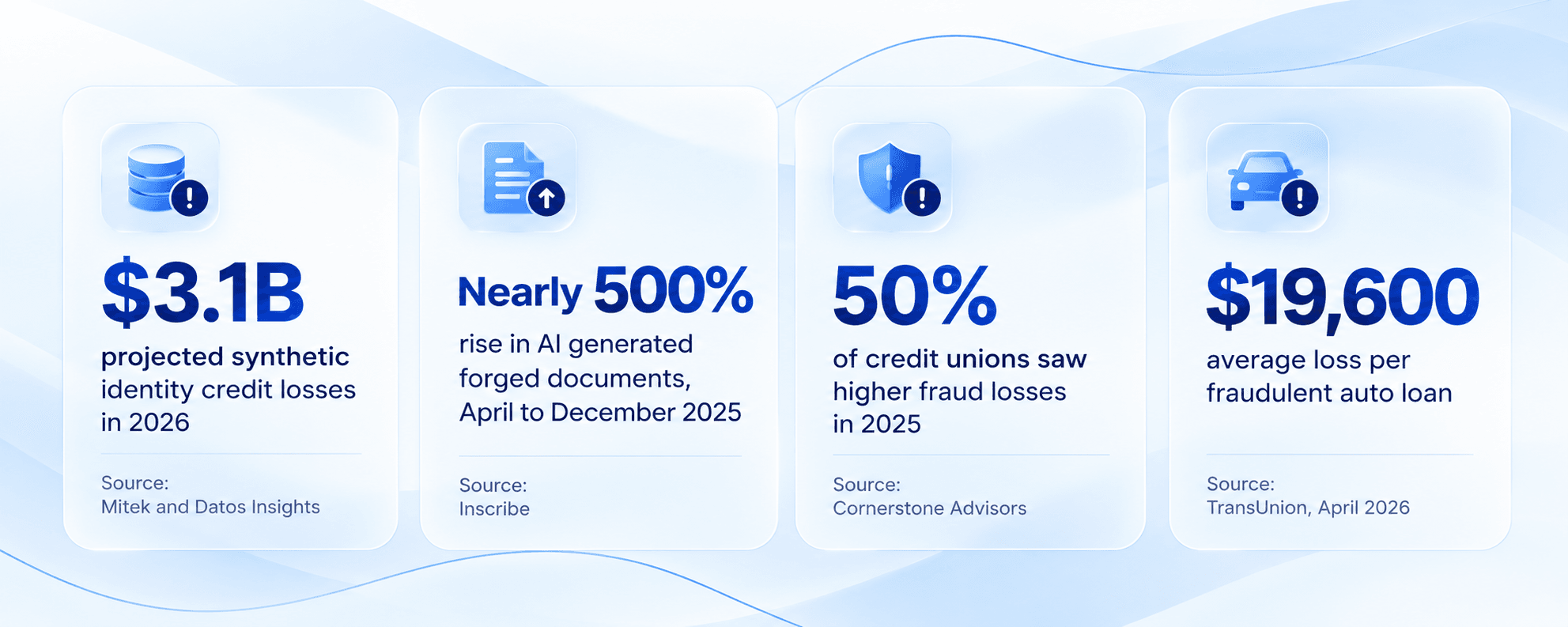
Start with the broad picture. Cornerstone Advisors found that roughly 40 percent of banks and 50 percent of credit unions saw higher fraud losses in 2025, and most expect another increase this year. Sardine's benchmarking survey of 165 fraud leaders at community banks and credit unions tells a similar story: losses are climbing at nearly three out of four institutions, and the median 2025 loss was $2 million, up from $1.63 million two years earlier.
Now zoom in on the application itself. Mitek and Datos Insights project that U.S. unsecured credit losses tied to synthetic identities will pass $3.1 billion in 2026, up from $1.8 billion in 2020 and growing about 16 percent a year. More than 80 percent of the fraud leaders they surveyed called synthetic identities a high or moderate risk to their application process. Credit unions are no side target, either. SentiLink's research found that 15 percent of synthetic identities target credit unions, and that credit unions tend to extend more credit to those invented people than to real ones.
Then there is the paperwork. Inscribe's research, as reported by Frank on Fraud, found that AI generated forged documents jumped nearly 500 percent between April and December 2025. MeridianLink wrote in April 2026 that tools like ChatGPT and Gemini can turn out a believable pay stub in about 90 seconds. In Inscribe's 2026 Document Fraud Report, 85.6 percent of the 90 fraud and risk leaders surveyed named bank statements the most vulnerable document type. And fake templates are cheap: some sell for as little as $10.
Auto lending feels it first. MeridianLink pegs auto fraud exposure at an estimated $10.4 billion for 2026, and TransUnion data as of April 2026, as reported by Crypto Briefing, puts the average loss on a fraudulent auto loan above $19,600.
Picture two security guards. The first one checks every visitor against a printed list. If your name is on it, you're in. The second one notices that the visitor on the list is wearing a borrowed badge, arrived in a car registered to someone else, and has walked past this door nine times this week under three different names.
The first guard is rules. The second one is closer to what AI adds.
Rules still matter. Does the Social Security number format check out? Does the address exist? Those checks catch lazy scams. But they only answer yes or no questions about one data point at a time. Models look at how the pieces relate to each other: whether this phone number, this email and this employer have ever appeared together before, whether the pixels on a pay stub were laid down in a way that suggests editing, whether the device filling in the form has touched forty other applications today.
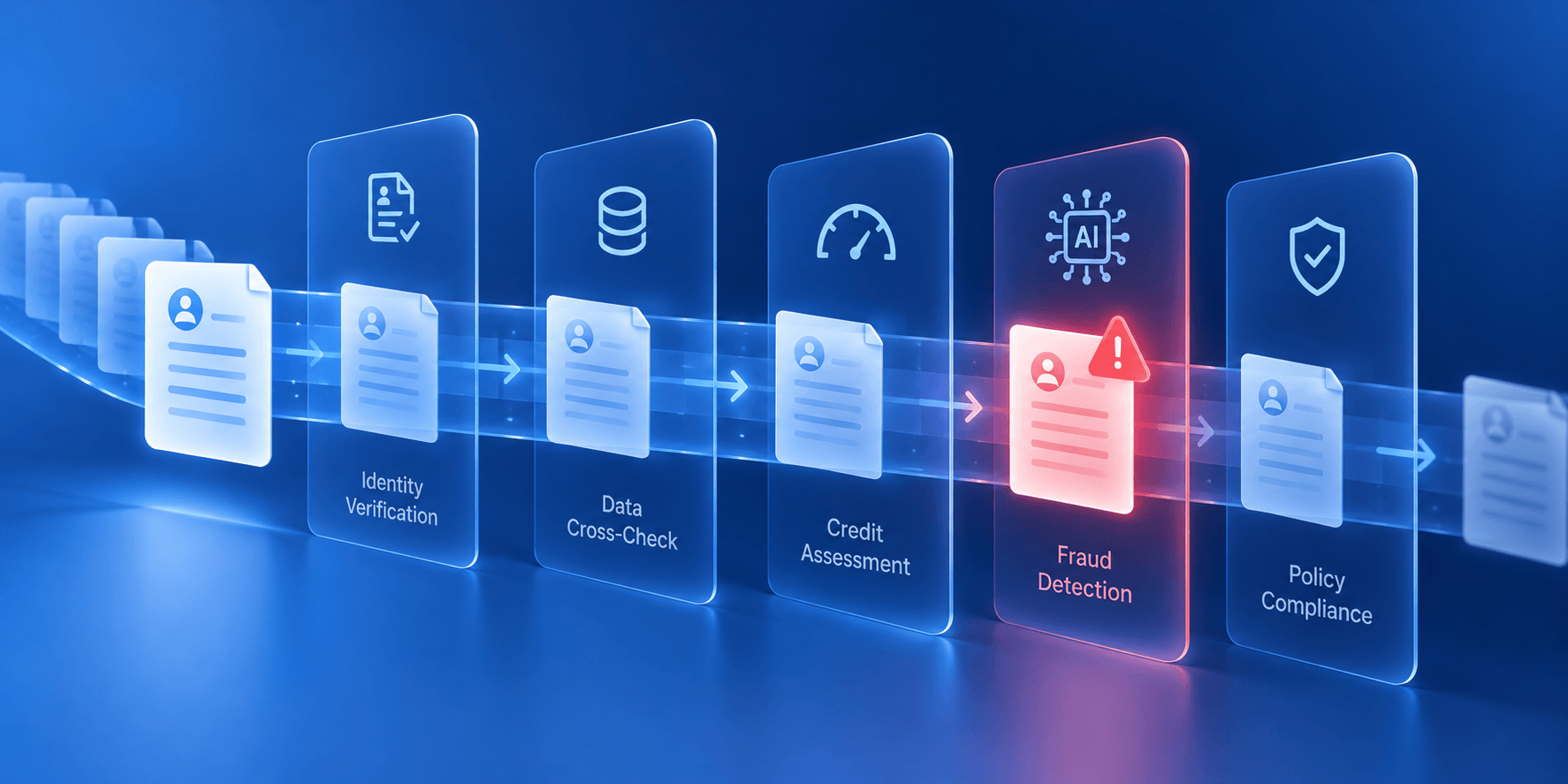
In practice, a good setup stacks several layers, and each one covers a blind spot in the others:
- Identity checks confirm the person exists and that the applicant is that person, using bureau data, and selfie liveness.
- Document forensics inspect files for edited metadata, odd fonts and spacing, and numbers that do not add up.
- Device and behavior signals look at how the application was filled out: copy and paste patterns, typing speed, location mismatches, emulators.
- Network and consortium intelligence spot identities, employers and devices that show up across many lenders.
- A decision layer blends all of the above into one risk picture and picks a path: approve the flow, add a step, or call in a person.
A synthetic identity mixes real details, often a genuine Social Security number, with invented ones. There is no victim to complain, which is exactly why these slip by. Patient operators nurture them for months, building a thin but clean credit history until the day they borrow big and vanish.
What helps: models that study how an identity came to exist. How old is the credit file compared to the person it claims to belong to? Do these data points share a history, or did they first meet last spring? Consortium signals matter here, because one lender rarely sees enough of the pattern alone.
Some of this damage shows up months later as ordinary delinquency, so it gets booked as credit risk. Plenty of institutions only discover the fake borrowers when they go back and look.
Here the identity is real, but the applicant is not that person. Maybe the data came from a breach. Maybe a family member is borrowing quietly in someone else's name.
What helps: matching the person holding the phone to the person on the ID, through selfie checks with liveness detection, plus phone and email intelligence that flags numbers ported last week or addresses with no history.
This is the one that keeps fraud teams up at night. A pay stub that once needed Photoshop skills now takes a prompt. A bank statement used to need a genuine template. Now the template costs ten dollars.
What helps: document AI that reads the file the way an examiner would, and then some. Does the year to date total match the pay period? Do the deposits on the bank statement match the pay stub? Do the fonts, spacing and file metadata look like they came from a payroll system, or from an image editor? Cross checking documents against each other catches what no single document gives away.
Point Predictive says it has identified more than 16,000 fake employers being used in fraud schemes. A single invented employer can appear on dozens of applications at different lenders, each one apparently verified by a friendly voice on a phone number that rings back to the scammer.
What helps: employer verification against independent sources, plus network matching that notices the same employer details, phone number or address turning up across unrelated people.
Fraud forums trade clips of faces that blink and smile on command. Worse, some attackers skip the camera entirely and feed prerecorded or generated video straight into a verification step, a trick known as an injection attack. Mitek and Datos Insights found that four in ten institutions already see higher attack rates tied to AI.
What helps: liveness checks that can tell a camera feed from an injected one, and device integrity signals that notice when something is off about the hardware itself.
Sometimes the person is real, the identity is real, and the lie is the story. An income rounded up. A debt left off. An intention to repay that was never there. Identity checks pass because there is nothing wrong with the identity.
What helps: comparing what the applicant says to what can be observed, such as bank data, payroll records and bureau history. When the stated income and the verified income disagree, that gap is worth a human look.
Abstract layers are easy to nod along to. Here is what it looks like for a single file.
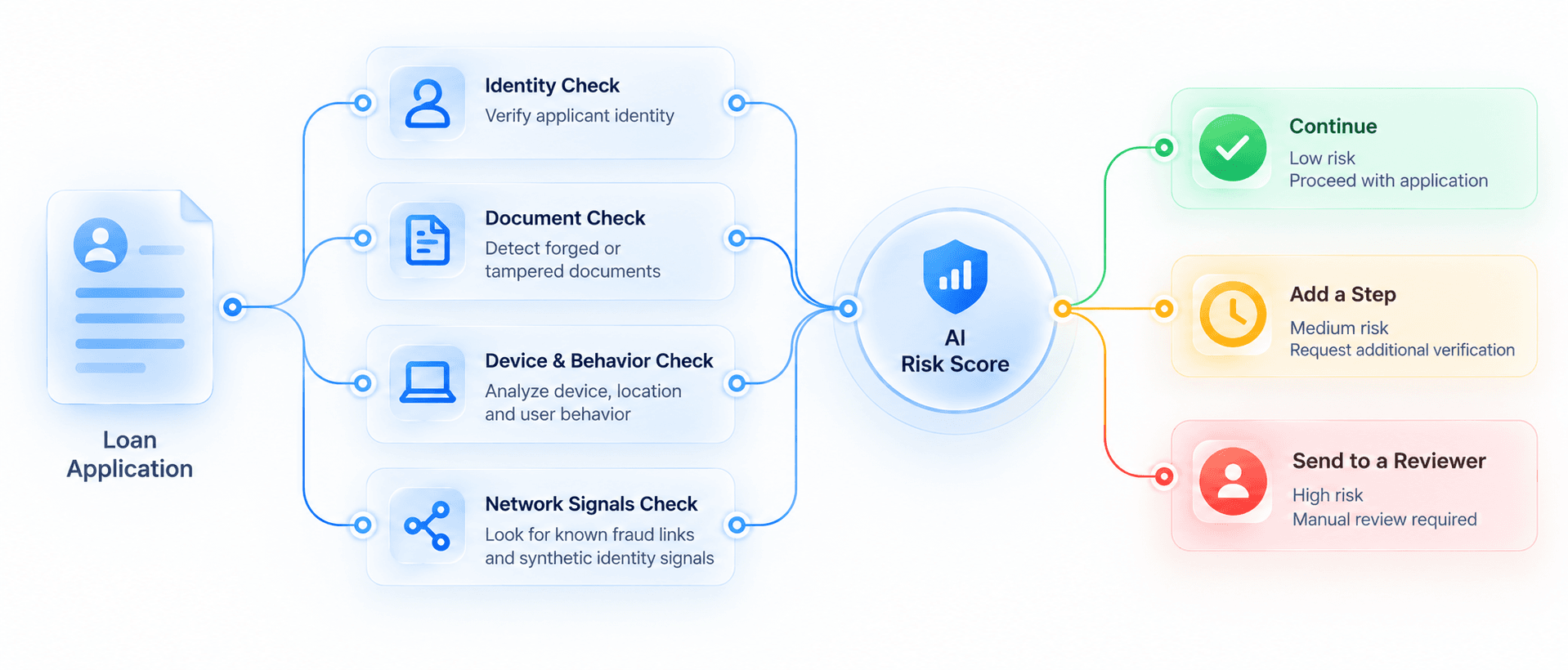
A member submits an auto loan application on their phone. Within seconds, before anyone opens the file, the platform confirms the identity against bureau and consortium data, checks the age and history of the phone and email, and looks at the device. As documents arrive, they get read and cross checked against each other and against the application. All of that rolls into a single risk picture.
Then the file takes one of three roads. Most applications sail through without anyone noticing a thing. Some get a small, specific request: a selfie, a bank connection, one more document. And a few get routed to a human reviewer's task list with the reasons attached, so they start with context instead of a hunch.
Here is where architecture matters more than any individual tool.
A fraud score sitting in its own portal, reviewed once a week, tells you about last week. A signal that appears beside the application it relates to, inside the same decision, can change the outcome before the loan funds. That difference is the whole game. Detection that runs separately from underwriting becomes a report. Detection that runs inside it becomes a control.
Some platforms are built around exactly this idea. Algebrik, for example, embeds SentiLink's real time scoring at the point of application and brings TransUnion's identity and fraud prevention tools into the same decisioning screen lenders already work in, so nobody toggles between systems to find the red flag.
If you want to go deeper on how decision engines blend fraud signals, scorecards and explainable reason codes, walks through the whole picture.
Here is the part vendors tend to skip. Every fraud control also catches some honest people.
The members most likely to trip an identity check are often the ones credit unions exist to serve: young borrowers, newcomers to credit, people with thin files. SentiLink notes that many lenders serving underserved populations cannot approve applicants whose identity cannot be verified, which is an expensive way to be safe. Tune too tight and you lose good members. Tune too loose and you fund the fakes. The same tension runs through the whole borrowing journey, which is why is worth a read alongside this one.
A few principles keep that balance honest:
- Match friction to risk. Most applicants should never see an extra step. Ask for more only when signals disagree.
- Treat a flag as a question, not a verdict. A human should look at a borderline file before anyone declines it.
- Attach the reason. A reviewer who sees why a file was flagged decides faster and fairer than one who sees a red dot.
- Watch your own outcomes. Track how many flagged files turn out clean. If the number is high, your thresholds need work.
NCUA has not issued a standalone AI rulebook. But its January 2026 Supervisory Priorities letter names AI oversight as an examiner focus area, and examiners are folding those questions into frameworks credit unions already answer to: third party due diligence, fair lending and operational risk.
For fraud tooling, that translates into a short list of things worth having on paper. What does each tool check? Who set the thresholds, and when were they last reviewed? Who looks at flagged files? How was the model tested for unfair outcomes? And what diligence did you do on the vendor? If a model contributes to a decline, your team should be able to explain why in plain language.
Fraud tooling is one line item on a longer evaluation list. If you are weighing options for a credit union, covers the wider checklist, including explainability and governance. For this piece alone, bring these to the table:
- Where does the check run: inside the origination workflow or in a separate portal?
- How does the system handle a low confidence reading? Does it flag the item for review or guess?
- Which signals feed the score, and can you see which ones drove a given result?
- How does it handle thin file and first time borrowers without rejecting them by default?
- Does it use consortium or network data, and from how many institutions?
- How are false positives measured and reported back to you?
- What audit trail exists for every flag, override and decision?
You do not need to rebuild everything. Three moves get most institutions moving.
First, find out what is already slipping through. Pull a sample of recent charge offs and early payment defaults and look for fraud markers instead of credit markers. Many institutions are surprised by how much "credit loss" was never really a credit problem. Then report fraud in delinquency as its own line so the board sees it clearly.
Second, begin with identity and documents. These are the two layers where manual review is slowest and AI is strongest, and they are the least controversial to explain to a board.
Third, run it quietly before you let it act. Score applications in the background for 60 to 90 days without changing any decision, then compare the flags to what actually happened. You will learn where thresholds need tuning before a single member feels it. For a wider look at which AI projects deserve a pilot first, see AI Solutions for Credit Unions: What's Hype vs. What Moves the Needle.
Fraud at origination is not new. What changed is how cheap it became to make a lie look professional, and how fast one working template can travel from lender to lender.
The answer is not a bigger wall at the front door. It is checks that run where decisions are made, a person who looks at the files that matter, and enough care that honest members glide through without noticing any of it.
Start by finding out what is already getting past you. Everything else gets easier from there.
Frequently Asked Questions
What is AI powered fraud detection in loan origination?
It is software that checks identity, documents, devices and behavior at the moment a loan application arrives, scores the risk, and routes suspicious files to a person before funding. It adds pattern recognition across data points that fixed rules cannot see on their own.
How does AI detect fake pay stubs and bank statements?
Can AI stop synthetic identity fraud?
Will AI fraud checks slow down or reject good borrowers?
What does NCUA expect when credit unions use AI for fraud screening?
Ready to get started?
More Blogs

Blog
Computerized Loan Origination: How Technology Transformed Lending
Blog
Loan Origination System Requirements: A Checklist Before You Buy

Blog
Consumer Finance Systems: Why Unified Platforms Win Over Fragmented Stacks